
Best Camping Skillets of 2026
When you’re out in the wild, a good meal can make or break your camping trip. But cooking over a campfire isn’t like cooking in your kitchen. You need tough, reliable gear that can handle high heat and messy conditions. A quality camping skillet is a must-have for frying eggs, searing steak, or making pancakes. With so many options out there, choosing the right one can be tricky. That’s why we’ve tested the best ones on the market to help you find the perfect pan for your next outdoor adventure.
1. Lodge Seasoned Cast Iron Skillet

- Material: Seasoned Cast Iron
- Handle Type: Easy-grip teardrop handle
- Country of Origin: Made in the USA
- Compatibility: Oven, stovetop, and campfire safe
The Lodge Seasoned Cast Iron Skillet is a legendary piece of outdoor cookware celebrated for its exceptional heat retention and incredible structural durability. It arrives pre-seasoned with a natural finish, making it ready for campfires or camp stoves right out of the box.
This heavy-duty frying pan features a comfortable teardrop handle that ensures excellent control while cooking meats or eggs. It is a highly versatile and long-lasting choice for any rugged camping environment where reliable performance is required.
Pros:
- Outstanding heat retention and uniform cooking
- Pre-seasoned natural non-stick surface
- Extremely durable and campfire compatible
Cons:
- Heavy to transport for backpacking
- Requires manual drying and oiling maintenance
See the Lodge Seasoned Cast Iron Skillet
2. NeoForge Cast Iron Skillet

- Coating: 100% PFOA and PFAS free
- Handle Design: Ergonomic Teardrop Handle
- Sizing Options: Available in multiple sizes
- Care Requirement: Hand-wash and occasional re-seasoning
The NeoForge Cast Iron Skillet is engineered to provide superior heat retention and uniform distribution, effectively eliminating hot spots during outdoor cooking. Its health-conscious design ensures that your camp meals remain completely toxin-free while adding natural iron to your diet.
Constructed to last for generations, this rugged skillet boasts an ergonomic teardrop handle that offers excellent balance when moving from camp stoves to open grills. It delivers a highly dependable cooking performance for family-sized feasts or individual portions alike.
Pros:
- Even heat distribution without hot spots
- Completely free from harmful chemicals
- Available in multiple versatile sizes
Cons:
- Regular hand-washing and re-seasoning required
- Bulky construction takes up storage space
See the NeoForge Cast Iron Skillet
3. Fire-Maple Camping Frying Pan

- Material: Hard Anodized Aluminum
- Weight: 9.2 ounces
- Folded Dimensions: 7.8 x 7.6 x 2.2 inches
- Handle Feature: Feast self-locking foldable handle
The Fire-Maple Camping Frying Pan is a lightweight and compact dream for backpackers looking to cook quality meals on the trail. Constructed from hard-anodized aluminum with a premium non-stick coating, it allows you to fry eggs and bacon without messy cleanup.
An engineered thicker bottom design provides even heating compared to standard camp pans, reducing the risk of burnt spots. The unique self-locking, heat-resistant handle ensures stable handling over low campfires and portable backpacking burners.
Pros:
- Extremely lightweight and backpack-friendly
- Thicker bottom prevents food from sticking
- Secure, space-saving foldable handle
Cons:
- Handle can damage if exposed to high flames
- Not suitable for heavy-duty metal utensils
See the Fire-Maple Camping Frying Pan
4. bodkar Frying Pan Skillet

- Size Diameter: 8 inches
- Material: Lightweight Aluminum
- Handle Type: Detachable Wooden Handle
- Capacity: 1 Liter volume
The bodkar Frying Pan Skillet is a highly specialized 8-inch outdoor pan featuring a striking black non-stick finish. Built from lightweight aluminum, this slick frying pan is specifically optimized to save precious space inside your camping gear boxes.
What sets this pan apart is its removable wooden handle, which provides a cool grip during cooking and detaches effortlessly for compact storage. It holds a convenient 1-liter capacity, making it perfect for quick solo meals on your outdoor adventures.
Pros:
- Detachable handle saves pack space
- Easy-to-clean non-stick coating
- Stay-cool wooden handle grip
Cons:
- Wooden handle is not oven-safe
- Smaller capacity limits family cooking
See the bodkar Frying Pan Skillet
5. CAROTE Nonstick Frying Pan
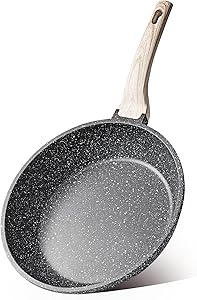
- Material Coating: Eco-friendly Classic Granite
- Chemical Safety: PFOS and PFOA free
- Base Type: High magnetic conductive stainless steel
- Stove Compatibility: All cooktops, including induction
The CAROTE Nonstick Frying Pan utilizes an eco-friendly classic granite material that makes your campsite cooking routine much healthier and safer. Its premium surface requires minimal oil, meaning you can easily cook breakfast with less smoke production.
Equipped with an extended stainless steel base, it conducts heat rapidly and evenly on any cooking heat source, including induction camp stoves. Cleanup requires a simple wipe with a paper towel, which conserves valuable water resources outdoors.
Pros:
- Effortless cleanup with minimal water
- Rapid and highly uniform heating
- Healthy, chemical-free non-stick surface
Cons:
- Lacks a space-saving folding handle
- Granite finish requires non-metal utensils
See the CAROTE Nonstick Frying Pan
6. Utopia Cast iron Skillet

- Seasoning Status: Pre-seasoned with vegetable oil
- Handle Comfort: Ergonomic easy-grip handles
- Versatility: Stovetop, oven, grill, campfire safe
- Washing Restriction: Not dishwasher-safe
The Utopia Cast Iron Skillet provides superior heat retention across its heavy-duty surface, yielding consistently great results for campfire searing or baking. It comes conveniently pre-seasoned with vegetable oil to give you immediate non-stick utility right out of the box.
The inclusion of ergonomically shaped handles facilitates safe handling when wearing thick protective outdoor oven mitts. This rugged skillet serves as an incredibly versatile cooking companion, transitioning seamlessly between indoor kitchens and open outdoor fire pits.
Pros:
- Ready for immediate campsite use
- Safe for rough open campfire cooking
- Ergonomic handle supports secure lifting
Cons:
- Regular oiling required after washing
- Too heavy for standard backpacking
See the Utopia Cast iron Skillet
7. SENSARTE Nonstick Frying Pan Skillet

- Coating Origin: Switzerland ILAG nonstick
- Handle Material: Woodgrain Bakelite (Oven safe to 302°F)
- Body Construction: Sturdy Cast Aluminum
- Care Maintenance: Dishwasher safe
The SENSARTE Nonstick Frying Pan Skillet features a top-tier Swiss ILAG non-stick coating that ensures healthy, PFOA-free cooking performance on the trail. Its sturdy cast aluminum core delivers enhanced longevity while remaining lightweight enough for car camping trips.
A thick, flat magnetic conductive stainless steel base ensures uniform heat distribution on all camp stoves, including induction tops. The comfortable woodgrain Bakelite handle stays cool to the touch during frying, making meal preparation incredibly safe.
Pros:
- Highly effective Swiss non-stick surface
- Dishwasher safe for easy post-trip care
- Flat base prevents rocking on stoves
Cons:
- Oven safety is restricted to 302°F
- Handle does not fold for packing
See the SENSARTE Nonstick Frying Pan Skillet
8. Armorbear Carbon Steel Frying Pan

- Weight Benefit: 30% lighter than cast iron
- Surface Treatment: Advanced rustproof nitriding
- Handle Design: Heat-resistant tilted wooden handle
- Stove Compatibility: Gas, electric, and induction
The Armorbear Carbon Steel Frying Pan combines the fast-heating properties of carbon steel with a construction that is 30% lighter than traditional cast iron cookware. Its unique oil-seasoning technology develops a chemical-free, natural non-stick layer that improves with use.
This durable skillet undergoes an advanced nitriding treatment to defend against rust in damp outdoor camping environments. The ergonomic, heat-resistant wooden handle is tilted perfectly to reduce wrist strain when flipping food over portable camp stoves.
Pros:
- Significantly lighter than cast iron pans
- Advanced nitriding prevents outdoor rust
- Tilted handle minimizes cooking fatigue
Cons:
- Requires initial rinsing before use
- Wood handle restricts open oven use
See the Armorbear Carbon Steel Frying Pan
How to Choose Camping Skillets
A camping skillet is more than just a pan you throw in the car. It is the centerpiece of your outdoor kitchen, the tool that turns a simple campfire into a place where real meals come together. Whether you are searing steaks over open flames, flipping pancakes on a morning propane stove, or baking cornbread in hot coals, the skillet you choose shapes what you can cook and how enjoyable the process will be.
The problem is that the market offers a dizzying array of options. Cast iron, carbon steel, stainless steel, aluminum, nonstick coatings—each material promises something different. Sizes range from tiny six-inch pans suitable for a single egg to massive sixteen-inch skillets that can feed a crowd. Some weigh less than a pound, while others tip the scales at over eight pounds. Choosing well requires understanding how these factors intersect with your actual camping style, cooking habits, and willingness to care for your gear.
Start with the Material
The material of your skillet determines nearly everything: how it heats, how much it weighs, how you clean it, and how long it lasts. There is no single best material, only the best material for your specific needs.
Cast Iron
Cast iron is the classic camping skillet material, and for good reason. It excels at heat retention, meaning once it reaches temperature, it stays there even when you add cold food. This makes it ideal for searing, frying, and any cooking that benefits from sustained, even heat. It works on every heat source—gas, electric, induction, and open campfire—which makes it extraordinarily versatile for outdoor cooking.
The trade-offs are weight and maintenance. A twelve-inch cast iron skillet typically weighs eight pounds or more, and even a ten-inch pan can feel heavy when loaded with food. Cast iron requires seasoning to maintain its nonstick surface and must be dried thoroughly after washing to prevent rust. It also reacts poorly to acidic foods like tomato sauce or wine, which can strip the seasoning and impart a metallic taste.
For campers who prioritize durability and cooking performance over portability, cast iron remains an excellent choice. A well-seasoned cast iron skillet improves with age and can last for decades, often becoming better than when it was new.
Carbon Steel
Carbon steel offers a compelling middle ground. It heats faster than cast iron and weighs significantly less—a twelve-inch carbon steel skillet typically weighs four to five pounds, roughly half the weight of its cast iron counterpart. Like cast iron, it develops a naturally nonstick seasoning layer over time and handles high heat beautifully, including open-fire cooking.
The maintenance requirements are similar to cast iron: it needs seasoning, must be kept dry, and can rust if neglected. Carbon steel is a favorite among professional cooks for its responsiveness and lighter weight, making it a strong option for campers who want cast iron performance without the heft.
Stainless Steel
Stainless steel is durable, resistant to rust, and non-reactive, meaning you can cook acidic foods without worrying about metallic flavors. It does not require seasoning, which simplifies care. However, stainless steel does not distribute heat as evenly as cast iron or carbon steel, and food tends to stick more readily unless you use sufficient cooking fat.
For camping, stainless steel skillets are often combined with an aluminum base to improve heat distribution. Stainless steel is a good choice for campers who value low maintenance and versatility over the exceptional searing performance of cast iron.
Aluminum and Nonstick
Aluminum is lightweight and conducts heat well, making it popular for backpacking and ultralight camping setups. The downside is that bare aluminum can react with acidic foods and is prone to warping over high heat. Most camping aluminum skillets feature a nonstick coating—often ceramic or PTFE-based—which makes cooking and cleanup remarkably easy.
Nonstick skillets are excellent for delicate foods like eggs, fish, and pancakes, requiring minimal oil. However, the coating will eventually wear out, especially if subjected to high heat or metal utensils, and nonstick pans are generally not suitable for open-fire cooking. For backpackers and campers who prioritize light weight and convenience, a nonstick aluminum skillet can be a practical choice, provided you treat it gently.
Choose the Right Size
Skillet size is a balance between cooking capacity and portability. The most common camping skillet sizes are measured by diameter, and each size serves different purposes.
| Size | Best For | Typical Weight (Cast Iron) | Considerations |
|---|---|---|---|
| 6–8 inches | Solo campers, single servings, eggs, small sides | 1–3 lbs | Light and packable; limited cooking capacity |
| 10–10.5 inches | Couples, small families, most meals | 4–5.5 lbs | The most versatile size; manageable weight for most campers |
| 12 inches | Families, group cooking, larger meals | 6–8 lbs | Heavy but offers generous cooking surface; consider assist handles |
| 14–16 inches | Large groups, base camping, car camping | 8+ lbs | Requires two hands; best for stationary camp setups |
For most campers, a ten to ten-and-a-half-inch skillet hits the sweet spot. It provides enough surface area to cook for two to three people comfortably without becoming unwieldy. A twelve-inch skillet is a reasonable upgrade for families, though the added weight becomes noticeable, especially when the pan is full.
If you are cooking for a larger group or primarily doing car camping where weight matters less, a larger skillet can be worthwhile. Just be aware that larger cast iron skillets can be difficult to handle and may not heat evenly on smaller camp stoves.
Consider Your Heat Source
Not all skillets work equally well on all heat sources. Before purchasing, verify compatibility with how you plan to cook.
- Campfire and coals: Cast iron and carbon steel are ideal. They handle extreme temperatures and actually benefit from the high heat. Avoid nonstick coatings, which can be damaged by open flames.
- Propane camp stove: Almost any material works, but cast iron and carbon steel excel because they retain heat well and distribute it evenly across the burner.
- Induction cooktop: Requires magnetic cookware. Cast iron and carbon steel work perfectly; aluminum and some stainless steel may not be compatible.
- Backpacking stove: Weight becomes critical. Aluminum or titanium skillets with nonstick coatings are the practical choice, though they require gentler handling.
Weigh the Importance of Handles and Design
Handle design might seem like a minor detail, but it matters significantly in camp cooking. Long handles keep your hands away from fire and heat, which is especially valuable when cooking over a campfire. However, long handles also make the skillet bulkier to pack.
Many camping skillets feature detachable or folding handles to save space. These designs are convenient for packing but can feel less secure during cooking. If you choose a folding-handle skillet, check that the locking mechanism is robust.
Helper handles—the smaller loop handles opposite the main handle—are a valuable feature on larger skillets. They allow you to use two hands for better control and safety when moving a heavy, hot pan. For skillets twelve inches and larger, a helper handle is almost essential.
Pour spouts are another useful design element, making it easier to drain grease or liquid without making a mess. Some skillets also feature deeper sidewalls, which increase capacity for one-pan meals and reduce splatter.
Decide How Much Maintenance You Will Tolerate
The care requirements of your skillet will affect how often you use it and how long it lasts. Be honest with yourself about your willingness to maintain your gear.
Cast iron and carbon steel require the most attention. They must be seasoned regularly, cleaned without harsh detergents (or with minimal soap), dried immediately after washing, and oiled before storage. This routine becomes second nature with practice, but it is not optional if you want the pan to perform well and resist rust.
Stainless steel and aluminum are more forgiving. They can be washed with soap and water, do not require seasoning, and are less prone to rust. However, they may not develop the same nonstick character over time.
Nonstick skillets are easy to clean but have a limited lifespan. The coating will degrade with use, especially if exposed to high heat or abrasive cleaning. If you choose nonstick, treat it carefully and expect to replace it eventually.
Match the Skillet to Your Camping Style
Your camping style should guide your final decision. A backpacker counting every ounce will make very different choices than a car camper who wants the best possible cooking experience.
- Backpacking and ultralight camping: Prioritize weight above all else. Look for aluminum or titanium skillets with ceramic nonstick coatings, removable handles, and compact nesting designs. A seven-to-eight-inch skillet is typically sufficient for one or two people.
- Car camping and weekend trips: You can afford to carry more weight and prioritize cooking performance. Cast iron or carbon steel in the ten-to-twelve-inch range offers the best balance of versatility and durability.
- Overlanding and RV camping: Space and weight are less constrained, so you can bring multiple skillets or larger sizes. Consider a nesting set or a versatile piece like a deep skillet with a lid.
- Bushcraft and open-fire cooking: Cast iron or carbon steel with long handles is ideal. Look for rugged construction and designs that prioritize heat retention and durability over light weight.
Final Thoughts
Choosing a camping skillet comes down to understanding your priorities. If you value cooking performance and durability above all, cast iron or carbon steel will serve you well for decades, provided you commit to their care. If convenience and light weight matter more, a quality nonstick aluminum skillet is a sensible choice. Size should match the number of people you typically cook for, and design features like handles and pour spouts can significantly improve your experience.
Ultimately, the best camping skillet is the one you will actually use—the one that fits your pack, your stove, your cooking style, and your willingness to maintain it. Start with a size and material that matches your most common camping scenarios, and you will find that a good skillet becomes one of the most valued pieces of gear in your outdoor kitchen.