Best Budget Camping Tents of 2026
Looking for a tent that won’t empty your wallet? You don’t need to spend a fortune to enjoy a night under the stars. We’ve tested the top affordable shelters to find the best cheap camping tents of the year. Whether you are a first-time camper or a seasoned pro, this guide will help you find a reliable, weatherproof home away from home without breaking the bank.
1. Kelty Wireless 2

- Sleeping Capacity: 2-person
- Floor Area: 30.2 square feet
- Number of Doors: 2 doors
- Pole Material: Fiberglass
The Kelty Wireless 2 is a reliable freestanding tent designed for 3-season camping. Its standout feature is the dual-door and dual-vestibule layout, which provides each sleeper with their own entrance and storage space for gear. The no-see-um mesh canopy ensures excellent ventilation during warmer nights while keeping insects out effectively.
This tent balances durability and value with its 68-denier polyester fabrics and water-resistant coatings. While the fiberglass poles make it slightly heavier for long backpacking trips, it remains a sturdy choice for car camping or short trail excursions. Setup is intuitive thanks to the three-pole design, offering a consistent peak height for comfortable sitting room inside.
Pros: Excellent ventilation, dual entry points, and generous vestibule storage.
Cons: Fiberglass poles are heavier and less durable than aluminum.
See the Kelty Wireless 2P 4P 6P 8P
2. UNP Tents 6 Person

- Sleeping Capacity: 6-person
- Floor Area: 90 square feet
- Peak Height: 78 inches
- Packaged Weight: 18 lbs
The UNP 6-Person tent is built for family comfort, featuring a massive floor plan that easily fits two air mattresses. Its most impressive attribute is the 78-inch center height, allowing most adults to stand fully upright while changing. The structure is reinforced by four steel leg poles, providing a stable and windproof rectangular roof design.
Ventilation is a priority here, with five mesh windows and a large mesh door allowing for a constant breeze. Despite its size, the tent is designed for a quick five-minute setup when two people are working together. It serves as an ideal basecamp for family car camping trips where internal living space and vertical headroom are the primary requirements.
Pros: Tall standing height, very spacious floor, and superior ventilation.
Cons: Large packed size and heavy weight make it unsuitable for hiking.
3. Kelty Daydreamer 4P

- Sleeping Capacity: 4-person
- Floor Area: 56.7 square feet
- Peak Height: 61 inches
- Rainfly Fabric: 75-denier polyester/5,000 mm
- Design: Freestanding
The Kelty Daydreamer 4P is a high-quality 3-season tent that prioritizes weather protection and interior comfort. It features a robust 5,000 mm Twilight Tech coating on the rainfly, which is significantly higher than many entry-level tents, ensuring you stay dry during heavy downpours. The 61-inch peak height provides ample vertical space for a four-person group.
Though it only features a single door, the 17.9 square foot vestibule provides a dedicated area for wet boots and gear. The 75-denier floor fabric is particularly rugged, offering better puncture resistance than thinner lightweight models. This tent is a great middle-ground for families who want a durable, freestanding shelter that can withstand more serious rain conditions.
Pros: High waterproof rating, durable floor fabric, and good peak height.
Cons: Only has one door, which can be inconvenient for four people.
See the Kelty Daydreamer 4P See the Kelty Daydreamer 6P
4. Coleman Skydome 4

- Sleeping Capacity: 4-person
- Floor Area: 56 square feet
- Vestibule Area: 28 square feet
- Packaged Weight: 13 lbs. 2.4 oz.
The Coleman Skydome 4 with a full fly and vestibule is designed for campers who value storage and easy access. The massive 28 square foot vestibule is one of the largest in its class, providing an expansive porch area for gear or shoes. Inside, the Skydome architecture offers nearly vertical walls, which creates 20% more headroom than traditional dome tents.
The construction uses flame-retardant materials and PFAS-free water repellents, making it a safer and more environmentally conscious choice. While it is on the heavier side, the freestanding design and pre-attached poles allow for a faster setup than many competitors. It is a sturdy, dependable option for weekend warriors who need extra room to store their camping equipment.
Pros: Massive vestibule for gear, increased headroom, and simple setup.
Cons: Relatively heavy and low waterproof rating on the fly fabric.
5. Kelty Discovery Basecamp 4

- Sleeping Capacity: 4-person
- Floor Area: 53 square feet
- Packaged Weight: 8 lbs. 8 oz.
- Number of Poles: 3
The Kelty Discovery Basecamp 4 is an excellent entry-level option for those transitioning into 3-season camping. It is notably lighter than the other 4-person tents in this list, making it easier to transport from the car to the campsite. The 58-inch peak height and three-pole configuration provide a stable structure with enough room for a small family.
Built with 68-denier polyester throughout, it offers a balance of weight and durability. The inclusion of a brow pole helps to pull the walls outward, maximizing the usable interior space. This tent is best suited for fair-weather campers who want a straightforward, no-frills setup that provides reliable shelter without adding excessive bulk to their gear collection.
Pros: Very lightweight for a 4-person tent and easy to pack.
Cons: Lacks a vestibule for external storage and has only one door.
See the Kelty Discovery Basecamp 4 See the Kelty Discovery Basecamp 6
6. Amazon Basics 3-Season Dome Camping Tent

- Capacity: 2-Person dome-style design
- Material: 100% Water-resistant coated polyester
- Setup: Shock-corded poles with snag-free sleeves
- Storage: Interior mesh pocket and compact carry bag
The Amazon Basics 3-Season Dome Tent is an entry-level powerhouse for hikers and backpackers seeking simplicity. Its free-standing structure and shock-corded poles allow for a stress-free setup that usually takes less than four minutes. The welded seams and water-resistant polyester coating provide a reliable barrier against light rain, making it a dependable choice for fair-weather camping trips.
Ventilation is well-handled by a removable rainfly and a dedicated cool-air port that maintains airflow even when the fly is attached. The interior mesh storage pocket keeps small essentials organized, while the compact bag ensures portability. While primarily designed for two people, it functions best as a spacious solo shelter with plenty of room for gear and a comfortable night’s sleep.
Pros: Very fast 4-minute assembly, effective cool-air port for ventilation, compact and lightweight.
Cons: Snug fit for two large adults, best suited for light rain only.
7. BISINNA Lightweight Backpacking Tent
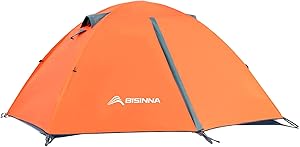
- Poles: 7001 Space aluminum alloy
- Waterproofing: PU2000mm water-resistant rainfly
- Doors: Dual D-shaped doors with zippers
- Weight: Compact design for easy backpacking
The BISINNA backpacking tent stands out due to its high-quality 7001 space aluminum poles, which offer superior strength-to-weight ratios compared to fiberglass. This double-layer tent is perfect for three-season use, featuring an inner tent made of breathable polyester and mesh, paired with a PU2000mm waterproof rainfly. The two-door design is a major convenience, allowing occupants to exit without climbing over one another.
Setup is incredibly intuitive; even a single user can have the tent pitched in under ten minutes. The inclusion of ten alloy pegs and two wind ropes ensures the structure remains stable during breezy conditions. Its small packed size makes it an ideal companion for hiking, fishing, or bikepacking expeditions where every inch of pack space is vital for a successful trip.
Pros: Durable aluminum poles for stability, double-layer design prevents condensation, two doors for easy access.
Cons: Aluminum stakes can bend in hard ground, vestibule space is somewhat limited.
8. Happy Travel 4-Person Dome Tent

- Height: 61-inch center height for extra headroom
- Material: 190T Polyester with PU3000mm coating
- Features: Electrical access port and double-end zippers
- Ventilation: Large mesh top for stargazing
The Happy Travel dome tent is designed with vertical space in mind, offering 20% more headroom than standard dome tents. This makes it a fantastic choice for small families or groups who want to fit a queen-size air mattress without feeling cramped. The PU3000mm waterproof coating on the rainfly provides impressive rain protection, while the thickened PE bottom ensures a dry floor even on damp grass.
Beginners will appreciate the clip-style setup, which allows two people to pitch the tent in about three minutes. An integrated electrical access port is a thoughtful touch for those using outdoor fans or chargers. The massive mesh ceiling provides excellent views for stargazing when the fly is removed, while also ensuring that heat is quickly vented during warm summer nights at the camp.
Pros: Spacious 61-inch center height, high 3000mm waterproof rating, convenient electrical cord access port.
Cons: Fiberglass poles are slightly heavy, large mesh area can be chilly in fall.
9. Coleman Sundome 2
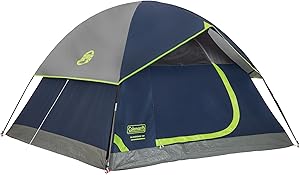
- Frame: Wind-responsive frame with fiberglass poles
- System: WeatherTec welded floors and seams
- Dimensions: 7 x 5 feet with 4-foot center height
- Ventilation: Large windows and ground vent
This version of the Coleman Sundome is optimized for couples or solo travelers who need a compact, navy-colored shelter. Like its larger counterparts, it features the proprietary WeatherTec system to keep moisture at bay. The 7×5 foot floor plan fits a single queen air mattress, while the ground vent and large windows work together to push warm air up and out, maintaining a comfortable interior temperature.
The snag-free, continuous pole sleeves mean you won’t struggle with the fabric during assembly, allowing for a 10-minute setup time. It is built to withstand winds up to 35 MPH, making it more rugged than many other budget options. This tent is a staple for weekend warriors who need a dependable, easy-to-carry shelter for casual camping trips and summer outdoor festivals.
Pros: Good wind resistance for its class, ground vent improves low-level airflow, durable bathtub-style floor design.
Cons: Only fits one queen mattress tightly, rainfly only covers the top portion.
10. Golabs CT1 2-Person Lightweight Tent

- Weight: Ultralight at only 4.4 lbs
- Fabric: 190D Polyester taffeta with PU1500mm
- Setup: Simple 3-minute assembly
- Extras: Lantern hook and two storage pockets
The Golabs CT1 is a standout choice for those looking to keep their pack weight down without spending hundreds. Weighing just 4.4 pounds, it is incredibly portable and sets up in a lightning-fast three minutes. The PU1500mm waterproof coating provides adequate protection for standard camping conditions, while the 190D polyester taffeta ensures the fabric can resist the usual wear and tear of nature.
Interior organization is simplified by a built-in lantern hook and two storage pockets to keep phones and headlamps within reach. The mesh skylight and large door allow for a natural breeze to flow through the tent, preventing it from becoming stuffy. This is an ideal partner for weekend hiking, beach days, or scouting trips where ease of use and portability are the primary concerns.
Pros: Extremely lightweight for the price, intuitive, lightning-fast 3-minute setup, great airflow through the mesh top.
Cons: Lower waterproof rating than some rivals, fiberglass poles require careful handling.
11. Night Cat One-Person Tent

- Safety: Fiberglass poles with protection cases
- Rating: Heavy rainproof PU3000mm fabric
- Dimensions: 7.0 x 3.8 x 3.6 feet
- Portability: Weighs only 4.4 lbs (2kg)
The Night Cat 1P tent is uniquely designed to protect the user’s hands with fiberglass poles that are fully covered in a protection case, preventing splinters during assembly. Despite its single-layer design, it boasts a massive PU3000mm waterproof rating and sealed seams, making it capable of handling heavy storms. It is perfectly sized for one person plus gear, or an adult and a small child.
Setup is straightforward, requiring just two poles to be inserted into diagonal sleeves. The compact package size is ideal for motorcyclists, bikers, and hikers who have limited storage space. With a mesh door and roof window, it provides excellent ventilation while keeping insects out. It serves as a fantastic, budget-friendly gift for boy scouts or solo adventurers looking for a rugged, storm-ready shelter.
Pros: Superior PU3000mm storm protection, pole cases prevent fiberglass splinters, compact enough for motorcycle camping.
Cons: Single-layer design can have condensation, very tight for two full-grown adults.
See the Night Cat One-Person Tent
How to Choose Budget Camping Tents
Determine Your Primary Camping Style
The most important factor in choosing a cheaper tent is how you plan to use it. Car campers can afford to choose heavier, larger tents with more headroom because weight isn’t a concern. If you are backpacking, weight is your biggest enemy; you should look for “ultralight” options that weigh under 5 pounds. For festival-goers, ease of setup and ventilation are key. Knowing your style helps you decide whether to prioritize a 61-inch center height for comfort or a 17-inch packed size for portability in a backpack.
Understanding Tent Capacity Ratings
Tent manufacturers usually rate capacity based on how many people can lie side-by-side like sardines. A “2-person” tent is generally perfect for one person and their gear. If you are actually camping with two people, you might want to look at a “3-person” or “4-person” tent to ensure you have enough room for bags, shoes, and movement. Always check the floor dimensions (in feet or inches) rather than just the person rating to ensure your sleeping pads will actually fit inside the space.
The Science of Waterproofing and PU Ratings
Camping tents often use a Polyurethane (PU) coating to keep water out. This is measured in millimeters (e.g., PU2000mm). This number represents the height of a water column the fabric can withstand before leaking. A rating of 1000mm is fine for light showers, while 3000mm is heavy rainproof. Additionally, look for “welded corners” or “factory-taped seams.” Taped seams mean a waterproof tape has been applied over the needle holes from stitching, which is the most common place for a tent to leak during a storm.
Evaluating Tent Materials: Polyester vs. Nylon
Most budget tents are made of polyester or nylon. Polyester is common in car-camping tents because it is durable and doesn’t sag when it gets wet. Nylon is often used in backpacking tents because it is lighter, though it can stretch slightly when damp. Look for the “Denier” (D) rating, such as 190T or 210D. A higher number generally indicates a thicker, more durable fabric. However, thicker fabrics also add weight, so you must balance durability with your need for portability.
Pole Materials: Fiberglass vs. Aluminum
Fiberglass poles are the standard for inexpensive tents. They are inexpensive and flexible but can be heavy and may splinter if they break. Aluminum poles (like 7001 series) are usually found in mid-range to high-end tents. They are lighter, stronger, and more resistant to wind. If you find a cheapest tent with aluminum poles, it is often a “best value” choice. Some brands now offer fiberglass poles with protective sleeves to prevent splinters, which is a great safety feature for families with children.
Ventilation and Condensation Management
Proper airflow is critical to prevent condensation from forming on the inside of the tent. Look for tents with large mesh panels, “ground vents,” or “cool-air ports.” A double-layer tent—which has a separate inner mesh body and a waterproof rainfly—is much better at managing condensation than a single-layer tent. In a double-layer design, your breath’s moisture passes through the mesh and collects on the fly rather than dripping onto your sleeping bag. Good ventilation also keeps the tent cool during hot summer nights.
Seasonality: Is it Really a 3-Season Tent?
Most budget tents are labeled as “3-season,” meaning they are designed for spring, summer, and fall. They can handle light wind and rain but are not built for heavy snow loads or extreme winter gales. A true 3-season tent should have a rainfly that covers at least the top half of the tent and a sturdy enough frame to stay upright in a 20-30 MPH breeze. If you plan to camp in colder weather, look for a tent with less mesh on the inner walls to help trap a bit of warmth.
Ease of Setup and Pole Design
No one wants to spend an hour fighting with poles in the dark. Modern tents often use “snag-free” sleeves or “clips” to attach the tent body to the poles. Clips are generally faster and allow for better airflow between the fly and the tent. Free-standing tents are also a major plus; they hold their shape without stakes, allowing you to move the tent around to find the flattest spot before finally staking it down. A setup time of under 10 minutes is a good benchmark for a modern dome tent.
Weight vs. Durability Trade-offs
A heavier tent usually uses thicker fabrics and more robust (but heavier) poles, which can lead to a longer lifespan. If you only camp a few times a year near your car, a 10-pound tent is perfectly fine. However, if you are carrying the tent on your back for 10 miles, you will regret every extra pound. For backpacking, aim for a “trail weight” of under 5 pounds. Keep in mind that “ultralight” budget tents may use thinner fabrics that require more care to avoid punctures from rocks or sticks.
Warranty and Brand Reputation
While you are looking for a “budget” option, brand reputation still matters. Established brands like Coleman or Amazon Basics offer consistent quality control and customer support. Check for a 1-year limited warranty, which protects you against manufacturing defects like broken zippers or missed seam taping. Reading recent user reviews is also vital to see how the tent performs in real-world rain and wind, as manufacturer claims can sometimes be overly optimistic regarding weather resistance.