
Best Hammock Sleeping Pads of 2026
A good night’s sleep in a hammock starts from below. Without a pad, cold air steals your warmth and the fabric can feel uneven. That’s why a hammock sleeping pad is a game-changer. It adds soft cushioning and traps body heat to keep your back warm. In this guide, we break down the best pads for comfort, weight, and price, so you can rest easy on your next camping trip.
1. Kammok Insulated Pongo

- R-Value: 3.1
- Pad Thickness: 3 inches
- Weight: 1 lb. 8.3 oz.
- Packed Size: 6 x 9.5 inches
The Kammok Insulated Pongo is a specialized air pad designed to bridge the gap between traditional tent camping and hammock setups. Its mummy shape and synthetic insulation make it an ideal companion for three-season adventures where temperatures might dip. The 3-inch thickness provides a plush barrier against the ground or the curved interior of a hammock, ensuring you stay comfortable throughout the night.
Constructed with durability in mind, this pad includes a repair kit and stuff sack for easy transport. While it is tailored for hammock users to prevent the dreaded cold backside, it performs just as reliably on a tent floor. At under two pounds, it maintains a reasonable weight-to-warmth ratio for hikers who prioritize versatility in their sleep system across different environments.
Pros: Excellent for hammock use, comfortable thickness, includes repair kit.
Cons: Slightly heavier than ultralight competitors, specific shape may limit foot room.
See the Kammok Insulated Pongo
2. POWERLIX Ultralight

- Design: Hexagon Body Mapping
- Material: Outdoor Grade TPU Nylon
- Inflation: 8-10 Pumps with Bag
- Features: 100% Waterproof
The PowerLix Ultralight sleeping mat stands out with its revolutionary hexagon design, engineered to support pressure points regardless of your sleeping position. This ergonomic approach ensures superior comfort for back, side, or stomach sleepers. The pad is remarkably easy to setup using the included inflation bag, which doubles as a pillow or waterproof storage, adding significant utility to your gear list without extra weight.
Durability is a core focus, featuring waterproof materials that protect you from damp ground and jagged rocks. It rolls up into a compact size that fits effortlessly into any backpack, making it a “must-have” for luxury seekers on the trail. Backed by a solid warranty and responsive customer service, it offers peace of mind for hikers venturing into various weather conditions and terrains.
Pros: Multi-functional inflation bag, ergonomic support, very affordable.
Cons: No specific R-value provided, hexagon cells can be difficult to clean.
3. Therm-a-Rest NeoAir XLite NXT

- R-Value: 4.5
- Weight: 13 oz. (Regular)
- Thickness: 3 inches
- Type: Ultralight Air Pad
The Therm-a-Rest NeoAir XLite NXT is a gold standard for backpackers who demand maximum warmth with minimal weight. With a 4.5 R-value, it is a true year-round performer that keeps you cozy even when the ground is frozen. This version retains the 3-inch thickness that side sleepers love while remaining one of the lightest pads on the market, packing down to the size of a water bottle.
Available in multiple sizes, including wide and large versions, it caters to all body types without forcing a weight penalty. The mummy shape saves space in tight tents, and the updated construction is noticeably quieter than previous generations. It is a premium choice for those who value high-performance engineering and a quiet night of rest under the stars during long-distance treks.
Pros: Incredible warmth-to-weight ratio, extremely compact, multiple size options.
Cons: Premium price point, mummy taper might feel narrow for some.
See the Therm-a-Rest NeoAir XLite NXT
4. REI Co-op Traverse Insulated

- R-Value: 4.3
- Thickness: 3.5 inches
- Shape: Rectangular
- Insulation: Synthetic
The REI Co-op Traverse Insulated air pad is designed for backpackers who refuse to sacrifice comfort for portability. Its rectangular shape provides more surface area than mummy pads, preventing your arms or legs from sliding off during the night. With a generous 3.5-inch thickness, it creates a luxurious cushion that smooths out even the most uneven terrain, making it ideal for restorative sleep after long miles.
Thermal performance is a highlight here, as the 4.3 R-value offers toasty warmth on cold nights. The synthetic insulation works efficiently to trap heat, ensuring three-season plus capability. While it is slightly heavier than ultralight mummy pads, the added stability and thickness make it a favorite for those who prioritize a bed-like feel in the backcountry without carrying a massive pack.
Pros: Extra thick for comfort, stable rectangular shape, great cold-weather insulation.
Cons: Heavier than mummy-shaped pads, larger packed volume.
See the REI Co-op Traverse Insulated
5. FUN PAC Camping Sleeping Pad
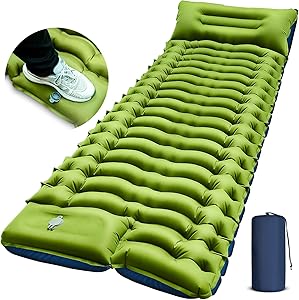
- Dimensions: 78 x 27 x 3 inches
- Material: 40D Nylon & TPU
- Inflation: Built-in Foot Pump
- Unique Feature: Connectable Side Buttons
The FUN PAC sleeping pad offers an extra-wide footprint and built-in pillow, focusing on convenience and group camping. The innovative egg-shaped air cells are designed to relieve pressure on the neck and back, while the 40D nylon construction ensures the pad survives rough environments. One of its best features is the side buttons, allowing you to snap two pads together to create a double bed for couples.
Setup is a breeze thanks to the integrated foot pump, which allows for full inflation in under a minute without using your breath or an external bag. This makes it an excellent choice for casual campers or those who want a quick camp setup. Despite its large inflated size, it remains portable and lightweight, similar to carrying a large water bottle, blending comfort with impressive ease of use.
Pros: Fast built-in inflation, wide dimensions, ability to join two pads.
Cons: Integrated pillow height isn’t adjustable, air cells may feel bouncy.
See the FUN PAC Camping Sleeping Pad
6. Therm-a-Rest NeoAir XTherm NXT

- R-Value: 7.3
- Weight: 15.5 oz. (Regular)
- Thickness: 3 inches
- Shape: Mummy
When the temperature drops well below freezing, the Therm-a-Rest NeoAir XTherm NXT becomes an essential piece of gear. Boasting an incredible 7.3 R-value, it offers the best warmth-to-weight ratio in its class. This pad is specifically engineered for extremely cold backcountry pursuits and alpine expeditions where staying warm is a matter of safety, yet it weighs less than a pound in the regular size.
The durable construction is designed to withstand the rigors of high-altitude camping while providing 3 inches of loft for comfort. Like the XLite, it features a space-saving mummy shape and a quiet interior that won’t disturb your sleep. For serious winter adventurers and mountaineers, this pad provides an unmatched combination of extreme thermal protection and ultralight packability that is hard to beat.
Pros: Market-leading R-value, extremely lightweight for winter gear, highly durable.
Cons: Expensive investment, overkill for summer or warm-weather camping.
See the Therm-a-Rest NeoAir XTherm NXT
7. REI Co-op Helix Insulated

- R-Value: 4.9
- Weight: 1 lb. 5 oz. (Medium)
- Thickness: 3 inches
- Insulation: Synthetic
The REI Co-op Helix Insulated pad is a versatile workhorse that provides a warm night’s sleep in any season. Its 4.9 R-value ensures that you stay insulated from the cold ground during late autumn or early spring trips. The 3-inch thickness is generous enough to accommodate side sleepers, providing enough cushion to keep hips and shoulders from bottoming out while maintaining a relatively low weight.
This mummy-shaped pad is designed to fit efficiently inside technical tents, saving weight where it matters most. It strikes a great balance between plush comfort and technical performance. Whether you are a weekend warrior or a dedicated backpacker, the Helix offers reliable warmth and a small packed size, making it a dependable choice for those who want one pad to handle most of their year-round adventures.
Pros: High R-value for the price, comfortable 3-inch loft, durable synthetic insulation.
Cons: Heavier than high-end ultralight models, mummy taper may feel restrictive.
See the REI Co-op Helix Insulated
8. Klymit Static V BASE

- R-Value: 1.3
- Thickness: 2.5 inches
- Weight: 1 lb. 2.1 oz.
- Inflation: 10-15 Breaths
The Klymit Static V BASE is a rugged and lightweight air pad designed for those who travel fast and light. Its signature V-chamber design is engineered to limit air movement and heat loss, while providing supportive “cradling” for your body. One of its standout features is the speed of setup, requiring only 10 to 15 breaths to reach full inflation, allowing you to settle into camp quickly.
While it has a lower R-value of 1.3, making it best suited for summer adventures or warm climates, its packability and price point make it an attractive entry-level option. The rectangular shape provides a bit more room than mummy pads, and the durable fabric can handle the occasional rough surface. It is a no-nonsense pad for hikers who want simple, reliable gear that won’t take up much space.
Pros: Very quick to inflate, budget-friendly, unique supportive V-chambers.
Cons: Not suitable for cold weather, thinner than many modern air pads.
9. NEMO Tensor All-Season

- R-Value: 5.4
- Thickness: 3.5 inches
- Weight: 1 lb. (Regular)
- Insulation: Synthetic
The NEMO Tensor All-Season is a top-tier choice for hikers who want a quiet, stable, and warm sleeping surface. With a 5.4 R-value, it is built for true four-season use, keeping you warm even when the frost sets in. The 3.5-inch thickness offers exceptional loft, ensuring that even side sleepers remain comfortable and suspended above the ground throughout the night without any sagging or instability.
NEMO has focused heavily on the user experience, utilizing internal baffles that make this pad much quieter than many of its competitors. It provides a stable, “non-bouncy” feel that mimics a real mattress. Despite its high insulation and thickness, it remains in the ultralight category, packing down small enough for long-distance backpacking trips where every ounce and every inch of space in your bag is critical.
Pros: Exceptionally quiet materials, thick and stable loft, great 4-season warmth.
Cons: Higher price point, inflation bag takes a little practice to master.
See the NEMO Tensor All-Season
10. Klymit Klymaloft SUMMIT

- R-Value: 2.4
- Thickness: 3.5 – 5 inches
- Weight: 2 lbs. 6.4 oz. (Regular)
- Type: Hybrid Foam/Air Pad
The Klymit Klymaloft SUMMIT is a hybrid sleeping pad that combines the best of both worlds: a plush foam topper for pressure point relief and air chambers for loft and support. This design provides a sleeping experience that feels more like a traditional mattress than a standard air pad. The foam topper contours to your body, while the I-beam air chambers ensure you stay stable and elevated off the ground.
Because of the integrated foam, this pad is heavier and bulkier than ultralight air pads, making it better suited for car camping or short backpacking trips where sleep quality is the priority. It inflates quickly and offers up to 5 inches of thickness in the XL version. If you often find air pads too firm or uncomfortable, the Klymaloft offers a unique, cushioned alternative that prioritizes luxury in the great outdoors.
Pros: Foam topper feels very comfortable, extremely thick, stable I-beam design.
Cons: Heavy and bulky for long hikes, low R-value for its weight.
See the Klymit Klymaloft SUMMIT
Mastering the Hang: A Comprehensive Guide to the Best Hammock Sleeping Pads
For many outdoor enthusiasts, the transition from tent camping to hammock camping is a revelation. The freedom from rocky ground, the gentle sway of the breeze, and the ability to set up camp on uneven terrain make hammocking an attractive alternative. However, new hammock campers often encounter a chilling realization during their first night: “Cold Butt Syndrome” (CBS). Because a hammock compresses your sleeping bag’s insulation against your body, the air moving underneath you quickly strips away heat. This is where a high-quality hammock sleeping pad becomes an essential piece of gear.
Choosing the right sleeping pad for a hammock is different than choosing one for a tent. In a hammock, you need a pad that can conform to a curved shape, provide lateral stability, and stay in place throughout the night. This guide explores the nuances of hammock insulation and how to select the best pad for your adventures.
Why You Need a Dedicated Pad for Hammocking
In a traditional tent setup, the ground is your primary source of heat loss through conduction. In a hammock, convection is the enemy. Even in relatively mild temperatures (60°F/15°C), the constant airflow beneath the hammock fabric will cool you down significantly. A sleeping pad provides a radiant barrier and a layer of dead air space that keeps your body heat where it belongs—next to you.
The Challenge of Fit and Form
Standard rectangular sleeping pads designed for ground use often struggle in a hammock. They tend to be stiff, causing them to “pop out” from under the sleeper or create awkward pressure points against the hammock walls. The best hammock sleeping pads are either specifically designed with a tapered shape or possess enough flexibility to wrap around the shoulders and hips, providing insulation where the hammock fabric cinches tightly against your body.
Types of Sleeping Pads for Hammocks
There are three primary categories of pads used in hammock camping: Closed-Cell Foam (CCF), Inflatable (Air Pads), and Self-Inflatables. Each has its own set of pros and cons depending on the climate and your backpacking style.
Closed-Cell Foam (CCF) Pads
CCF pads are the most budget-friendly and durable option. They are virtually indestructible; you can poke holes in them, and they still provide warmth. For hammock use, CCF pads are excellent because they are thin and flexible. Many experienced hangers use a wide CCF pad and trim it to a custom shape that covers the shoulders and torso. The downside is their bulk—they don’t compress, so they must be strapped to the outside of a pack.
Inflatable Air Pads
Inflatable pads offer the most comfort and the smallest pack size. Modern ultralight air pads can provide significant warmth-to-weight ratios. However, a fully inflated air pad can feel “bouncy” in a hammock and may slide around. To remedy this, many hammock-specific air pads feature “wings” or side baffles that expand to insulate the shoulders and keep the pad centered. Another tip is to under-inflate the pad slightly, allowing it to conform to the hammock’s curve better.
Self-Inflatable Pads
These pads combine open-cell foam with an airtight skin. They offer a middle ground in terms of comfort and durability. While they are heavier than pure air pads, the internal foam provides a more stable, non-slip surface which can be beneficial inside a nylon hammock. However, they are often the most difficult to fit into a narrow hammock setup due to their relative rigidity.
Key Features to Look For
When shopping for the best hammock sleeping pad, keep the following specifications in mind to ensure you don’t end up with a “mismatch” that ruins your sleep.
R-Value: The Measure of Warmth
The R-value measures a pad’s resistance to heat loss. For summer hammocking, an R-value of 1.0 to 2.0 is usually sufficient. For three-season use, look for something between 3.0 and 5.0. If you plan on winter hammocking, you will likely need an R-value of 5.0 or higher, or a combination of a pad and an underquilt.
Shape and Width
Standard pads are 20 inches wide. In a hammock, this is often insufficient because your shoulders and elbows will press against the cold sides of the hammock. Look for “Large” or “Wide” models (25-30 inches) or pads specifically designed with a “mummy” or “v-shape” to provide lateral coverage.
Non-Slip Textures
One of the biggest frustrations in hammock camping is waking up to find your pad has slid halfway up the wall of the hammock. Some manufacturers add silicone “grip” dots or use brushed fabrics to increase friction between the pad and the hammock. If your pad is too slippery, you can add small dots of seam sealer to the bottom of the pad to create your own DIY grip.
Top Recommendations for Different Camping Styles
Not every camper has the same needs. Here is how to choose based on your specific priorities.
Best for Ultralight Backpackers
For those counting every gram, a 3/4 length closed-cell foam pad is the gold standard. It protects the vital organs and torso while your empty backpack can be placed under your legs for minimal insulation. Alternatively, high-end insulated air pads offer better R-values for less weight, though at a significantly higher price point.
Best for Side Sleepers
Sleeping on your side in a hammock requires a “flat lay,” which is achieved by sleeping at a diagonal angle. A thicker inflatable pad (3-4 inches) can actually help flatten the hammock’s curve, making it easier for side sleepers to find a comfortable position without their knees or hips feeling pinched.
Best for Cold Weather
In truly cold conditions, many hammockers switch to an “Underquilt” (an insulated blanket that hangs outside the hammock). However, if you prefer pads, look for an insulated inflatable pad with reflective internal barriers. Combining a thin CCF pad with an inflatable pad is also a popular “stacked” method for extreme cold.
Pro Tips for a Better Night’s Sleep
Even the best pad requires a bit of technique to work perfectly in a hammock environment.
The Double-Layer Hammock Advantage
If you are serious about using a pad, consider purchasing a double-layer hammock. These hammocks have a sleeve between two layers of fabric where you can slide your sleeping pad. This keeps the pad perfectly in place and prevents your skin from sticking to the plastic surface of the pad.
Inflation Pressure
Do not inflate your air pad to its maximum capacity. A rock-hard pad will feel like a balance beam in a hammock and will likely squirt out from under you. Deflate it just enough so that it becomes supple and wraps around your body. This increases the contact surface area and provides much better insulation for your sides.
The Diagonal Lay
Always remember to lie at an angle (about 30 degrees) relative to the centerline of the hammock. This creates the flattest sleeping surface. Your pad should be positioned at this same angle. If the pad is too stiff to sit diagonally, it is a sign you need a more flexible pad or a wider hammock.
Conclusion
A hammock sleeping pad is more than just a cushion; it is your primary defense against the elements. While underquilts are a popular premium option, a well-chosen sleeping pad offers versatility, allowing you to move to the ground if no trees are available (a “go-to-ground” scenario). By focusing on flexibility, width, and an appropriate R-value, you can transform your hammock from a simple backyard swing into a high-performance, four-season sleep system. Whether you choose the rugged reliability of foam or the plush comfort of an air pad, the right insulation will ensure that your only worry is which view to wake up to in the morning.