

Best Compasses For Survival of 2026
Finding your way in the wilderness is a critical survival skill, and a good compass is the most reliable tool for the job. Unlike a phone or GPS, it never needs batteries and won’t break if you drop it. Whether you are an experienced hiker or a beginner learning navigation, having the right compass can literally be a lifesaver. Here are our top picks for the best survival compasses to keep you on the right path.
1. Suunto M-3 NH

- Increments: 2 degrees
- Declination Adjustment: Yes
- Magnifying Lens: Yes
- Weight: 1.62 ounces
The Suunto M-3 NH is a professional-grade baseplate compass designed for those who venture into demanding environments. Its construction is rugged and reliable, featuring a high-grade steel needle with a jewel bearing for smooth operation. The inclusion of a built-in magnifying lens and luminescent markings makes it an excellent choice for low-light navigation or detailed map work where precision is non-negotiable.
This model stands out due to its adjustable declination scale, allowing users to compensate for the difference between true north and magnetic north easily. It is liquid-filled for needle stability and includes a lanyard for secure carrying. Whether you are an experienced mountaineer or a search and rescue professional, this compass provides the high-accuracy tools needed for survival in extreme conditions.
- Pros:
- Global balancing and adjustable declination
- Luminescent bezel for night navigation
- Cons:
- Slightly heavier than basic recreational models
- Larger footprint on a map
2. Cammenga Official US Military Tritium Compass

- Illumination: 7 Tritium micro-lights (12-year glow)
- Durability: Shockproof, sandproof, and waterproof
- Temperature Range: -50° F to 150° F
- Design: Official US Military lensatic style
The Cammenga 3H Tritium Compass is the gold standard for tactical land navigation. Built to rigorous military specifications, this lensatic compass thrives in environments that would destroy lesser equipment. Its standout feature is the self-powered tritium illumination, which provides a constant glow for over a decade without needing batteries or sunlight. This makes it a dependable lifeline for nighttime operations or navigating in low-light forest canopies.
Constructed with an olive drab metal housing, the unit is entirely sandproof and functional in extreme temperatures ranging from desert heat to arctic cold. The package includes a sturdy carrying pouch and lanyard, ensuring it stays secure on your person. Whether you are a professional soldier or a dedicated survivalist, this compass offers unmatched precision and battle-tested reliability that you can trust in any crisis situation.
- Pros:
- Requires no external light source
- Extreme temperature resistance
- Military-grade durability
- Cons:
- Heavier than plastic models
- Higher price point
3. Suunto Clipper L/B NH

- Increments: 10 degrees
- Liquid-Filled: Yes
- Dimensions: 1.2 x 0.94 inches
- Weight: 0.18 ounce
The Suunto Clipper L/B NH is an incredibly compact and lightweight micro-compass that offers secondary navigation at a glance. It is specifically designed to clip onto watchbands, sleeves, or the edges of maps, ensuring that you always have a general heading available without reaching into your pack. Despite its tiny size, it is liquid-filled to ensure the needle remains stable while you are on the move.
While it lacks the precision required for complex orienteering, it serves as a perfect backup tool or a quick reference for hikers and urban explorers. The luminous points allow for basic orientation in the dark. It is a minimalist’s dream, weighing less than a quarter of an ounce, making it a virtually unnoticeable addition to your gear list until the moment you need it.
- Pros:
- Ultra-lightweight and extremely portable
- Clips easily to watch straps or gear
- Cons:
- Large 10-degree increments limit precision
- No declination adjustment or scales
4. Suunto A-10 NH

- Increments: 2 degrees
- Scale 1:24,000: Yes
- Declination Scale: Fixed
- Weight: 1.06 ounces
The Suunto A-10 NH is the quintessential baseplate compass for general outdoor recreation and learning. It is designed to be fast, simple, and highly accurate, making it the ideal choice for scouts, students, or casual hikers. The clear plastic baseplate allows for easy map reading, while the 2-degree increments provide the precision necessary for standard land navigation tasks in ordinary weather conditions.
Equipped with a fixed declination correction scale and a convenient snap-lock lanyard, this compass is easy to detach for use on a map. It focuses on the essential features without the added bulk of more advanced survival tools. This makes it a reliable workhorse for those who need a dependable navigation aid that is straightforward to operate and light enough to carry on any day hike.
- Pros:
- Simple and intuitive for beginners
- High-quality steel needle and jewel bearing
- Cons:
- Lacks a magnifying lens
- No adjustable declination for high-accuracy work
5. Coghlan’s Carabiner Liquid-Filled Compass

- Weight: 0.6 ounces
- Dimensions: 1.2 x 2.7 x 0.4 inches
- Material: Black aluminum construction
- Feature: Integrated carabiner clip
Coghlan’s Outdoor Carabiner Compass is designed for the minimalist hiker who needs quick, hands-free directional checks. This liquid-filled unit ensures smooth needle movement, providing accurate readings even when moving through rugged backcountry trails. Its aluminum housing offers surprising durability for such a lightweight tool, making it a reliable backup or primary navigation aid for casual day hikes and camping trips where weight is a concern.
The built-in carabiner allows you to clip the compass directly to a backpack strap or belt loop, ensuring it is always within reach. It also features luminous directional markers that glow in the dark, aiding visibility during early morning expeditions or late-night arrivals at camp. While it lacks advanced sighting features, its portability and ease of use make it an excellent addition to any emergency survival kit.
- Pros:
- Ultra-lightweight aluminum body
- Convenient carabiner attachment
- Affordable backup navigation
- Cons:
- Lacks professional sighting optic
- Small dial size
6. Anbte Professional Waterproof Metal Compass

- Body Material: High-quality zinc alloy
- Special Tool: Built-in sighting clinometer
- Accuracy: Integrated bubble level
- Waterproof Rating: IP65 certified
The Anbte Professional Compass is a multifunctional tool tailored for hunters, geologists, and serious outdoor enthusiasts. The heavy-duty zinc alloy body is waterproof and shockproof, built to endure extreme weather conditions without losing calibration. A unique feature is the integrated clinometer and graduated scale, which allows users to measure slopes and heights—a vital skill for mountain navigation and tactical planning in the field.
To enhance precision, Anbte included a bubble level to ensure the compass is perfectly flat for the most accurate reading possible. The luminescent design allows the magnet arrow and dial to be read in complete darkness after exposure to sunlight. With a tripod screw hole on the base, this compass can be mounted for professional surveying tasks, making it a versatile choice for any adventure or technical geological work.
- Pros:
- Includes slope measurement clinometer
- Tripod mountable for high precision
- Rugged waterproof construction
- Cons:
- Requires sunlight to “charge” glow
- More complex for beginners
7. AOFAR Military Lensatic Sighting Compass

- Dial: 360° scale floating dial
- Capsule: Thermoelastic liquid-filled
- Optics: Adjustable prism lens
- Extra: Map measurer distance calculator
AOFAR’s Military Compass AF-4580 is a feature-rich lensatic sighting tool that excels in positioning and mapping tasks. The thermoelastic liquid-filled capsule ensures the dial remains stable even during rapid movements or temperature shifts. It features an adjustable prism lens for clear readings of the dial while sighting, along with a heavy-duty zinc die-cast body that provides excellent protection against drops and rough handling in the wilderness.
Beyond basic navigation, this model includes a map measurer and distance calculator on the side, allowing you to estimate travel time and route lengths directly on topographic maps. The luminous markings and sighting line facilitate high-accuracy bearings in various lighting conditions. Provided with a waterproof pouch and lanyard, it is a comprehensive navigation kit for camping, hiking, and professional mapping expeditions where accuracy is paramount.
- Pros:
- Built-in map distance calculator
- Adjustable prism for easy reading
- Durable zinc die-cast frame
- Cons:
- Liquid capsule can develop bubbles
- Multiple markings may clutter dial
8. Proster IP65 Survival Sighting Compass
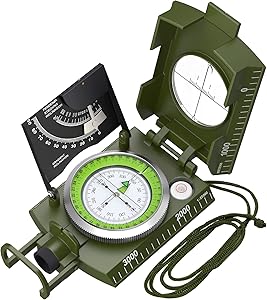
- Weight: 330 grams
- Feature: Vertical Lubber line optic
- Specialty: Integrated clinometer for slopes
- Housing: Foldable metal lid
The Proster IP65 Compass is a professional-grade metal instrument designed to decrease errors through its high-precision sighting optic. The inclusion of a vertical Lubber line allows you to align your target with extreme accuracy, while the floating 360-degree dial provides immediate data. Like its high-end counterparts, it serves as a clinometer to measure height and slopes, making it as useful for geological activities as it is for backcountry survival.
This compass is built to be shakeproof and waterproof, allowing it to function under the most extreme weather conditions. The fluorescent markings on the needle and card dial absorb sunlight for nighttime visibility, ensuring you aren’t left stranded after dusk. Its foldable metal lid protects the internal glass components when not in use, making it a rugged, long-lasting companion for boating, climbing, or hunting trips.
- Pros:
- High-precision sighting optic
- Strong IP65 waterproof rating
- Dual-use as a clinometer
- Cons:
- Heavier than most hiking compasses
- Dial can be sensitive to tilt
9. TurnOnSport Orienteering Baseplate Compass

- Material: Clear Acrylic Baseplate
- Scales: 1:24000 ruler scale
- Bezel: 360-degree rotating
- Optic: Built-in magnifying glass
The TurnOnSport Orienteering Compass is the ideal entry-level tool for Boy Scouts, Girl Scouts, and beginner survivalists. Unlike lensatic models, this baseplate compass is designed to lay flat on a map, allowing users to use the 1:24000 ruler and orienting lines to plot precise routes. The clear acrylic construction ensures you can see the topographic map details underneath, while the magnifying glass helps identify small geographical landmarks and legends.
This lightweight device features a liquid-filled capsule that ensures the magnetic needle swings fast and points toward north without annoying bubbles. Its simple, intuitive design makes it an excellent educational gift for children, teaching them the fundamental skills of land navigation. Portable enough to fit in a pocket or hang from the included lanyard, it is a vital safety tool for any field trip or backpacking expedition.
- Pros:
- Perfect for map route plotting
- Very affordable and lightweight
- Includes a magnifying lens
- Cons:
- Not as rugged as metal models
- No sighting mirror or prism
10. Sportneer Military Grade Lensatic Compass

- Construction: Waterproof and shakeproof metal
- Optic: Rear sight magnifying lens
- Glow: Fluorescent interface
- Carry: Belt loop and carrying case
The Sportneer Compass offers professional-grade military features in an ergonomic, user-friendly design. Its lensatic function uses a magnifying lens on the rear sight to enlarge the card dial, ensuring you get a highly accurate bearing every time. Tough and tenacious, this compass is built to survive the harshest hikes, featuring a waterproof and shakeproof metal housing that protects the internal liquid-filled capsule from impact and moisture.
Designed for portability, it comes with a belt loop attachment and a dedicated carrying case, allowing you to keep your hands free while climbing or navigating dense brush. The interface features fluorescent markings that glow in the dark, allowing you to soldier on even after night falls. It is a reliable emergency tool for military usage or anywhere the beaten track leads, offering a great balance of durability and price.
- Pros:
- Magnified dial for easy reading
- Ergonomic metal construction
- Great value for the price
- Cons:
- Luminescent paint fades over time
- Case is basic nylon
How to Choose Compasses For Survival
In an age where we rely heavily on digital maps and GPS, the humble compass remains one of the most vital pieces of survival gear. Electronic devices are prone to battery failure, signal loss, and hardware malfunctions. A high-quality analog compass, however, will always point you toward magnetic north. Understanding the different types of compasses and their technical features is the first step toward mastering land navigation.
Understand the Three Primary Compass Types
Before buying, you must determine which style of compass fits your specific survival needs. Each has its own strengths and intended use cases.
Lensatic Compasses
Commonly referred to as military compasses, lensatic models consist of a base, a cover that contains the sighting wire, and a rear lens. The lens allows you to read the dial while simultaneously sighting a distant landmark. These are generally the most rugged and precise for taking long-distance bearings.
Baseplate Compasses
Ideal for orienteering and map work, baseplate compasses feature a clear plastic base. This allows you to lay the compass directly over a topographic map and see the details beneath. They often include rulers and scales for measuring distances.
[Image of baseplate compass on a map]
Sighting Mirror Compasses
These are a hybrid of the two. They feature a fold-out mirror that allows you to see the compass dial while sighting a landmark. They are excellent for both map work and taking accurate field bearings, though they are often more expensive than basic models.
Crucial Features to Look For
Not all compasses are created equal. When your life depends on finding your way home, these technical features become non-negotiable.
Global Needle vs. Northern Hemisphere Needle
Due to the Earth’s magnetic field, needles are usually balanced for specific regions. If you plan to travel globally, look for a “global needle” that functions accurately in both the northern and southern hemispheres without tilting and dragging against the housing.
Declination Adjustment
Magnetic north (where your needle points) and true north (where the map points) are rarely in the same spot. This difference is called declination. Higher-end survival compasses allow you to manually adjust for this offset, so you can read map bearings directly without doing mental math during a stressful situation.
Liquid-Filled Capsules
A liquid-filled housing dampens the needle’s movement, allowing it to settle quickly and remain stable as you walk. Look for “bubble-free” capsules, as large air bubbles can interfere with the needle’s rotation.
Durability and Visibility
A survival compass must withstand the elements. Look for models with metal housings (like zinc alloy or aluminum) if you expect rough handling. Additionally, ensure the compass has “glow-in-the-dark” or luminescent markings. Tritium-filled models are the best, as they don’t require external light to “charge” their glow, providing visibility throughout the night.
Integrated Tools
Some survival compasses include extra features like clinometers for measuring slope angle (useful for avalanche safety) or magnifying glasses for reading small map details. While useful, ensure these don’t make the tool too bulky for your carry style.
Maintenance and Safety Tips
Always keep your compass away from metal objects like knives, electronics, or vehicle magnets, as these can temporarily or permanently “re-polarize” the needle, causing it to point in the wrong direction. Always test your compass before a trip and carry a backup if you are heading into unknown territory.