
Best Winter Camping Tents for Cold Weather
Camping in winter can be fun but also very cold. You need the right gear to stay safe and warm. One of the most important things is a strong tent. Winter tents are made to handle snow, wind, and freezing temperatures. They keep you dry and protect you from the cold. Choosing the right tent can make your trip much better. Some tents are great for heavy snow, while others work better in windy places. In this guide, we’ll help you find the best winter camping tents. We looked at warmth, strength, size, and price. Whether you’re a beginner or expert, there’s a good option here for you.
1. OneTigris Stella

- Weight: 4.41 pounds (2kg)
- Dimensions (Setup): 6.9ft x 4.1ft x 3.7ft (2.1m x 1.25m x 1.15m)
- Water Resistance: 3000mm waterproof rating
- Material: 20D nylon outer, 40D nylon floor, single-layer silicone coating
The OneTigris Stella is a solid four-season camping tent built for serious adventurers. Weighing just 4.4 pounds, it’s impressively lightweight for its durability and weather protection. The 20D nylon outer with a silicone coating resists harsh wind and rain, while the 40D nylon floor keeps moisture out from below. Its easy dome-style setup with flexible poles is great for quick pitching, even in cold conditions. Thanks to the dual-door design, access is easy, and the added mesh inner ensures good airflow, a rare bonus in cold-weather tents. Whether you’re hiking, backpacking, or ski touring, this tent feels like a premium model without the heavy price tag.
User experience backs up the specs. Reviewers praise its build quality, comparing it to $500+ tents, and it holds up in heavy snow and rain. At over six feet tall, the interior is surprisingly roomy, and the vestibules, while not huge, are functional for cooking in bad weather. Updates like added mesh panels improve versatility for warmer weather. And with its included kit—stakes, guy lines, poles, and a storage bag—it’s ready for adventure right out of the box. For budget-conscious hikers who need a trustworthy shelter year-round, the Stella delivers outstanding value.
Pros:
- Excellent value for a four-season tent
- Lightweight yet strong construction
- Dual doors with improved airflow
- Fully waterproof with good ventilation
Cons:
- Vestibules could be roomier
- Not ideal for hot summer conditions
2. REI Co-op Arete ASL 2

- Design: 4-pole all-season structure with large vestibule
- Material: 40D nylon rainfly with no-wick welded construction
- Ventilation: Adjustable cross-flow vents and zippered mesh panels
- Weight: Lightweight for a 4-season tent (exact weight not listed)
The REI Co-op Arete ASL 2 is a versatile 4-season tent built for adventurers who want strength without extra weight. With a four-pole design, it holds up in tough weather like snow and wind, yet remains light enough for backpacking, bikepacking, and kayak trips. The interior is roomy for two people, with smart additions like a wide vestibule, large door, and multiple storage pockets. Ventilation is excellent thanks to adjustable vents and closeable mesh panels. Setup is quick and intuitive with color-coded poles and sleeves. The tent adapts well to both winter and warmer seasons, and its rainfly is strong and resists sagging even in wet conditions.
In real-world use, the Arete ASL 2 proves to be reliable in nearly every climate. Users report it performs well in heavy rain, freezing temperatures, and summer heat. It’s durable and practical, with thoughtful details like door pockets, reflective guylines, and compatibility with skis or splitboards. While it’s a bit pricier now than it was in 2022, the quality still justifies the cost. A couple of minor drawbacks are the short guy lines and lack of enough stakes for serious wind, but those are easily fixed. Overall, the Arete ASL 2 continues to impress as a dependable, all-weather tent with an ideal balance of toughness and portability.
Pros:
- Strong, all-season structure with roomy interior
- Great ventilation and condensation control
- Easy to set up and pack
- Lightweight for its class
Cons:
- Doesn’t include enough stakes or long guy lines
- Price has increased, reducing overall value
3. Coleman PEAK1

- Capacity: 4-person
- Weather Protection: 2,000mm waterproof fabric with taped seams and tub-style floor
- Structure: 7000-series aluminum poles withstand winds up to 45 mph
- Design Features: 2 doors, vestibules, star view window, and included footprint
The Coleman PEAK1 is a smart choice for small groups venturing into the backcountry. Designed for 4 people, it offers generous interior space and a tall ceiling, making movement inside easy. Two wide doors and vestibules give plenty of room to store packs and gear, while the included footprint adds protection and extends the tent’s life. The frame is impressively strong, with aluminum poles that hold firm in winds up to 45 mph. Setup is quick, even solo, thanks to the clip system. The tent also features a star view window, which provides a great view of the night sky and increases airflow on warm nights.
While the tent performs well in varied conditions, it does have a few design limitations. The all-mesh walls above the tub floor reduce privacy, especially if the front vestibule is open. With only one solid fabric layer on the door, airflow and privacy don’t always balance well. Adding a second, partially solid door panel would improve comfort in both wet and dry weather. Despite that, the PEAK1 holds up as a reliable and user-friendly tent, particularly for those who value ventilation and stargazing. It’s a great pick for weekend backpackers who want solid performance without the high price tag.
Pros:
- Excellent airflow and stargazing window
- Sturdy frame handles tough wind
- Easy solo setup with included footprint
- Spacious interior for three people
Cons:
- Limited privacy due to all-mesh lower walls
- Only one door has solid material, affecting airflow and privacy balance
4. BISINNA 4-Season Tent
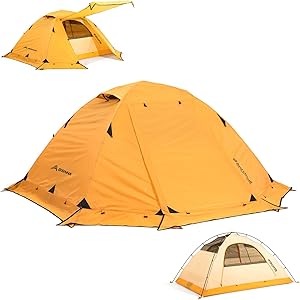
- Dimensions: 82.6″ (L) x 59″ (W) x 43.3″ (H)
- Weight: 2.9 kg (6.4 lbs)
- Material: 210T tear-resistant polyester with PU 3000mm waterproof coating
- Features: Snow skirt, dual doors and windows, UV protection, freestanding aluminum pole design
The BISINNA 4 Season Tent is a reliable and affordable option for campers needing year-round performance. Built with sturdy 210T polyester and a PU 3000mm waterproof coating, it holds up well in snow, rain, and cold. The snow skirt adds extra insulation in winter, while the two-door, two-window design ensures airflow during warmer trips. Its spacious interior comfortably fits two people with room to stash gear in the waterproof foyer or outside under the fly. The freestanding structure with two aluminum poles makes setup fast and easy—even for solo campers. It’s also impressively lightweight for a four-season tent, weighing just 6.4 pounds.
Users report solid performance in snowy and wet mountain conditions, with minimal moisture inside as long as snow is cleared from the fly. The ventilation helps manage condensation effectively, though care must be taken not to let the inner and outer layers touch. Zippers can get sticky if the vestibule is too tight, but they hold up well with careful use. The tent packs down into an 18x7x7-inch sack, which is a bit bulky but manageable for most backpacks. Overall, the BISINNA 4 Season Tent offers impressive durability, comfort, and all-weather protection at a price point that’s hard to beat for a true four-season shelter.
Pros:
- Excellent value for a four-season tent
- Great ventilation and dual doors/windows
- Strong waterproofing and wind resistance
- Easy solo setup with lightweight design
Cons:
- Zippers can snag if vestibule is tightened too much
- Bulkier than some ultralight options when packed
5. Naturehike KOTA
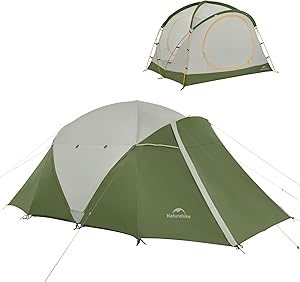
- Dimensions: 173.2″ (L) x 104.3″ (W) x 74.8″ (H); floor width: 94.5″
- Weight: 19.8 pounds (8.98 kg); packed size: 23.6″ x 10.6″ x 10.6″
- Material: 210T polyester with 4000mm PU coating (fly) and 5000mm PU-coated oxford floor
- Features: Double-wall design, two vestibules, internal storage pockets, guy lines and stakes included
The Naturehike KOTA 4-Person Tent is a spacious and reliable shelter built for comfort on extended camping trips. With a peak height of nearly 75 inches, it provides plenty of room to stand up, move around, or even set up camp chairs inside. The double-wall structure and large vestibules make it suitable for long stays, giving campers both excellent storage space and solid protection from rain and wind. Ventilation is decent, thanks to its dual windows and airflow design, while internal pockets keep gear organized. Despite its generous size, the tent packs down compactly and remains easy to carry for group hiking and car camping.
The tent’s waterproofing is excellent, featuring a 4000mm-rated fly and 5000mm-rated floor—enough to handle extended wet weather. Setup is fairly straightforward once you get used to the color-coded pole sleeves, although the printed instructions leave much to be desired. One notable drawback is that the sleeping area windows cannot be adjusted from inside, making ventilation management slightly inconvenient during storms or cold nights. Still, the build quality is solid, with durable materials and sturdy poles that hold up in rough conditions. The Naturehike KOTA is a great all-around option for campers wanting a large, weather-resistant tent with solid comfort features at a fair price.
Pros:
- Very spacious interior with full standing height
- Excellent waterproofing and durable construction
- Two large vestibules for gear storage
- Packs down compactly for its size
Cons:
- Sleeping area windows can’t be adjusted from inside
- Poor setup instructions with minimal guidance
6. Forceatt Camping Tent

- Dimensions: 86.6″ x 51.1″ x 43.3″
- Weight: 5.68 lbs; packed size: 41cm x 14cm
- Material: Polyester with PU3000–PU5000 waterproof coating
- Structure: 7001 aluminum poles, iron stakes, and taped seams for all-season protection
The Forceatt Camping Tent is a lightweight, compact 2-person shelter built to handle a wide range of weather conditions. It features a tough polyester body with a waterproof PU coating up to 5000mm, plus strong aluminum poles and wind-resistant guy lines. The hexagonal shape gives it good stability, and the interior is roomy enough for two people—though it’s especially comfortable for one. With dual D-shaped doors, gear storage in both side vestibules, and mesh windows plus ceiling vents, the tent offers excellent ventilation and easy access. It also includes gear pockets in all four corners and an overhead pouch to keep essentials close.
Setup is fast and easy, typically taking only a few minutes. The zippers are high-quality, and the floor is made from thick material that holds up well on rugged ground. Ventilation is a standout feature—even during a rainy night, there’s minimal condensation inside. For taller users, the length may be slightly snug, but most standard air mattresses will still fit. While it’s not as long as some might prefer, it’s a great all-rounder for solo or duo use. The Forceatt strikes a nice balance between durability, packability, and performance, making it one of the better value four-season tents in its weight class.
Pros:
- Quick and easy setup and takedown
- Excellent waterproofing and sturdy frame
- Dual doors and vestibules for convenience
- Great ventilation with no condensation issues
Cons:
- Slightly short for users over 6 feet tall
- Tight fit for two with gear inside
7. GEERTOP 4-Person Tent

- Dimensions: 94.4″ (L) x 82.6″ (W) x 53″ (H)
- Weight: 4.15 kg (9.1 lbs)
- Material: 210T breathable polyester inner, 210D PU 5000mm Oxford floor, 210T PU 3000mm fly
- Features: 2 doors, 2 ventilation windows, snow skirt, aluminum poles, double-stitched sealed seams
The GEERTOP 4-Person 4-Season Tent is a lightweight, compact, and budget-friendly shelter for campers who want year-round performance without breaking the bank. Weighing just 9.1 pounds, it’s easy to pack and carry for backpacking or family outings. The materials feel durable, with a high waterproof rating—3000mm on the fly and 5000mm on the floor—providing dependable protection in wet weather. The tent includes dual doors and ventilation windows, improving airflow and reducing condensation. The snow skirt and sturdy aluminum poles make it suitable for cold-weather use, while the vestibule can be converted into a sunshade with trekking poles, offering extra versatility.
In practice, the tent holds up well in dry winter conditions and offers ample space for a small family or a group of four. Users find setup quick and simple, even solo, thanks to the two-pole dome design. One recurring challenge is managing condensation: if the rainfly touches the inner tent, moisture builds up quickly. To prevent this, it’s important to use extra stakes and tension straps properly. The inner storage pockets are a useful touch, keeping small gear organized. While not ideal for heavy snow or extended storms, the GEERTOP tent performs well in three-season and light winter conditions—offering good value for campers seeking durability, space, and portability.
Pros:
- Lightweight and compact for a 4-person tent
- Excellent waterproofing on floor and fly
- Easy to set up solo
- Good airflow with dual doors and vents
Cons:
- Prone to condensation if fly touches inner tent
- Not ideal for heavy snow or extreme winter weather
How to Choose Winter Camping Tents for Cold Weather?

Camping in winter can be a beautiful and unforgettable experience, but it also presents some serious challenges. Snow, wind, freezing temperatures, and condensation can turn a fun trip into a miserable one if you’re not prepared. One of the most important pieces of gear you need for winter camping is the right tent. Unlike summer tents, cold-weather tents are designed to withstand harsh conditions and keep you safe and warm. This guide will walk you through everything you need to know when choosing a winter camping tent.
1. Understand What Makes a Tent “Winter-Ready”
Winter tents, also known as four-season tents, are built differently from their three-season counterparts. They’re not just for snowy conditions—they’re for any environment where wind, snow, and cold are serious threats. These tents offer:
-
Stronger frames to handle wind and snow loads
-
More fabric and fewer mesh panels for insulation
-
Better waterproofing and seam sealing
-
Vestibules for gear storage and snow protection
Three-season tents may survive a chilly fall night, but they won’t hold up in a snowstorm. A winter tent is built for performance, not just comfort.
2. Consider the Type of Winter Camping You’ll Be Doing
The right tent for you depends on where and how you plan to camp:
-
Backpacking or Alpine Expeditions: Go for lightweight, compact four-season tents. Look for streamlined shapes and strong poles.
-
Basecamp or Car Camping: You can opt for heavier tents with more interior space and features since weight is less of an issue.
-
Snow Camping or Mountaineering: You’ll need high-end tents with reinforced poles, steep walls to shed snow, and excellent waterproofing.
Understanding your needs will help you avoid overbuying (or underpreparing).
3. Tent Shape Matters
The shape of a winter tent plays a big role in how well it handles snow and wind.
-
Dome Tents: Popular for their strength and ease of setup. Their rounded design sheds snow and resists wind.
-
Geodesic Tents: These use multiple intersecting poles for extreme stability. Ideal for mountaineering or exposed locations.
-
Tunnel Tents: Great for space and weight savings, but they don’t handle snow as well unless well guyed out.
-
A-Frame Tents: Traditional and simple, but not as wind-resistant unless heavily reinforced.
Choose a shape based on the worst-case weather conditions you expect to face.
4. Pay Attention to Materials and Construction
Materials make a big difference in how a tent performs in winter. Look for:
-
Tent Fabric: Ripstop nylon or polyester with PU coatings for waterproofing. Check for a minimum of 2000–3000mm waterhead rating for the rainfly and higher for the floor (e.g., 5000mm).
-
Poles: Aluminum poles are stronger and better suited for cold than fiberglass. DAC Featherlite or 7001-series aluminum is preferred.
-
Seams: Taped or factory-sealed seams are a must to prevent leaks.
-
Zippers: Two-way zippers help ventilate while keeping snow out. Check for snag-free zips with storm flaps.
Build quality matters more in winter than in summer camping—cheap gear can fail when you need it most.
5. Ventilation Is Crucial
In winter, condensation can be more dangerous than rain. If warm air from your breath condenses and freezes on the tent walls, it can make the interior damp and cold. Look for:
-
Roof vents and side vents: These allow warm, moist air to escape.
-
Double-wall design: A breathable inner tent and waterproof outer fly help manage moisture.
-
Mesh panels (with covers): Limited mesh is okay as long as it’s sealable to retain warmth.
Good airflow prevents condensation without letting in snow and cold air.
6. Check the Size and Interior Space
Space is important in winter camping. Bulky sleeping bags, extra gear, and the need to cook or change clothes inside all demand more room.
-
Vestibules: These are essential for storing wet boots, packs, and cooking gear outside the main tent body.
-
Floor space: Choose a size that’s comfortable. A two-person winter tent often feels snug—consider sizing up if weight isn’t a concern.
-
Height: Being able to sit up or kneel inside is a comfort bonus, especially during long nights.
More space means more comfort, but also more weight and surface area for wind to attack.
7. Weight vs. Durability Trade-Off
Winter tents are usually heavier than summer tents. This is due to extra materials, stronger poles, and reinforced construction. Consider:
-
Ultralight 4-season tents: Ideal for alpine missions but may sacrifice interior space and comfort.
-
Heavier basecamp tents: Best for car camping or group trips where comfort is prioritized over packability.
-
Packed size: Ensure the tent fits in your pack or can be divided among group members.
Balance your priorities—don’t sacrifice safety for a few pounds of weight savings.
8. Ease of Setup in Cold or Windy Conditions
In freezing weather, the last thing you want is to spend 45 minutes setting up your tent. Look for:
-
Simple pole sleeves or clips: Color-coded poles and fast clips save time.
-
Freestanding design: These are easier to pitch on frozen ground or snowpack.
-
Snow stakes or guy-out loops: Regular tent stakes don’t hold in snow. Check if the tent includes or supports snow anchors.
Practice setting up your tent before your trip—it’ll save you trouble in real conditions.
9. Extra Features to Consider
While not essential, these features can greatly improve your cold-weather camping experience:
-
Snow skirts: Flaps at the base of the tent keep out snow and wind.
-
Stove jacks: Allow you to safely use a wood stove in hot tents (for specialized winter shelters).
-
Storage pockets and hang loops: Useful for organizing gear inside when you’re stuck indoors.
-
Reflective guylines and details: Help you find and avoid tripping over your tent in the dark.
Small touches can make big differences in comfort and safety.
10. Budget and Value
Winter tents range from budget-friendly models around $150–$250 to high-end expedition tents costing $600+. Ask yourself:
-
How often will I use this tent in true winter conditions?
-
Do I need a tent for mountaineering or just occasional snow camping?
-
What’s my comfort and safety worth in extreme weather?
Some excellent value tents offer four-season protection without the premium price tag—just be sure they meet the standards for your needs.
Final Thoughts
Choosing the right winter camping tent is all about balancing safety, comfort, weight, and cost. Know where you’re going, what conditions to expect, and what features matter most to you. A good four-season tent can make all the difference between a miserable, freezing night and a warm, safe, and memorable winter camping experience.
Take your time, do the research, and invest in a tent that matches your needs. Because when the snow starts falling and the wind picks up, your tent is your only line of defense—and it needs to be ready.