Best Budget Backpacking Stoves of 2026
For hikers and campers who want hot meals without burning a hole in their wallet, finding the right gear is key. You don’t need expensive equipment to cook well in the wild. A reliable, affordable stove makes all the difference. This article breaks down the best budget backpacking stoves that are light, durable, and easy on your budget.
1. MSR PocketRocket 2

- Weight: 2.6 ounces
- Average Boil Time (1L): 3 min. 30 sec.
- Burn Time (Max Flame): Approx. 60 min.
- Dimensions: 3.1 x 1.7 x 1.3 inches
The MSR PocketRocket 2 is a legendary choice for backpackers who prioritize a minimal footprint without sacrificing power. This next-generation model improved upon the celebrated original by becoming even lighter and more compact. Its folding pot supports are designed to accommodate a wider variety of cookware sizes while maintaining a surprisingly sturdy platform for your trail meals.
In terms of performance, it remains a speed demon, boiling a liter of water in just three and a half minutes. It is an ultralight staple that fits easily into a solo mug. While it lacks a built-in igniter, its reliability and simplicity make it a go-to for many long-distance hikers looking for a durable, high-performance canister stove.
Pros: Extremely lightweight, compact folding design, fast boiling speeds.
Cons: Lacks integrated ignition, prone to wind interference without a screen.
2. Fire-Maple Fixed Star 1
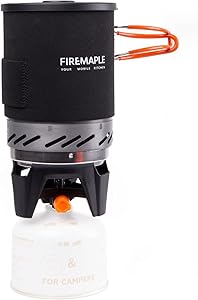
- Weight: 18 ounces
- Capacity: 1 Liter cook pot
- Ignition: Built-in piezoelectric
- Material: Hard anodized aluminum
The Fire-Maple Fixed Star 1 is an integrated stove system designed for maximum efficiency and convenience. By utilizing advanced heat exchange technology, this stove significantly reduces boiling times and minimizes the impact of wind compared to standard setups. The entire system, including the stove and a fuel canister, nests neatly inside the included pot for easy transport.
Safety and durability are central to this design, featuring a locking stainless steel handle and a protective neoprene cover to prevent burns. It is an excellent all-in-one solution for those who want a fast, reliable kitchen setup without buying separate components. Note that it is compatible with most standard canisters but will not work with Coleman branded fuel.
Pros: High fuel efficiency, integrated all-in-one system, included heat exchanger.
Cons: Heavier than minimalist stoves, not compatible with Coleman canisters.
3. Soto WindMaster

- Weight: 3.1 ounces
- Burn Time (Max Flame): 90 min. (250g canister)
- Average Boil Time (1L): 4 min. 2 sec.
- Dimensions: 5.7 x 3.8 x 1.3 inches
The Soto WindMaster is specifically engineered to handle the harsh conditions that often defeat other canister stoves. It features an award-winning micro regulator that maintains a consistent output even as the fuel canister gets cold or runs low. This ensures you can cook a hot meal in high altitudes or chilly mornings without the typical pressure drop issues.
This model comes with the 4Flex pot support, providing a wide and stable base for larger pots. Its recessed burner head acts as a natural windshield, which is why it performs so well in gusty environments. For trekkers who frequently face unpredictable weather, the WindMaster offers a perfect balance of ultralight weight and professional-grade reliability and performance.
Pros: Excellent wind resistance, micro regulator for cold weather, stable pot supports.
Cons: Slightly slower boil time than competitors, larger profile when deployed.
4. MSR PocketRocket Deluxe

- Weight: 2.9 ounces
- Average Boil Time (1L): 3 min. 18 sec.
- Auto Ignition: Yes
- Fuel Type: Isobutane-propane canister
The MSR PocketRocket Deluxe takes the proven foundation of the PocketRocket line and adds premium features for a better cooking experience. It is only marginally heavier than the standard version but includes a highly durable push-start piezoelectric igniter. The broader burner head is a significant upgrade, distributing heat more evenly to allow for actual simmering rather than just boiling.
Performance-wise, this is one of the fastest stoves in the MSR lineup, clocking a boiling time of just over three minutes. It also includes a pressure regulator to maintain steady heat in cold weather or when fuel is low. It represents the gold standard for backpackers who want a lightweight stove that doesn’t compromise on functionality or ease of use.
Pros: Integrated igniter, broad burner for simmering, pressure regulated.
Cons: More expensive than the base model, slightly larger storage size.
5. Snow Peak BiPod

- Weight: 7.76 ounces
- Average Boil Time (1L): 4 min. 30 sec.
- Burn Time (Max Flame): 45 min. (4 oz. canister)
- Auto Ignition: Yes
The Snow Peak BiPod stove is an innovative hybrid designed for users who oscillate between casual car camping and lightweight backpacking. Its unique two-legged design provides exceptional stability, especially when using larger pots that might tip over on smaller, more traditional ultralight stoves. This makes it an ideal choice for groups or those who prefer more elaborate trail cooking.
Despite its sturdier build, it remains relatively portable and features an integrated auto-ignition system for convenience. While it isn’t the fastest boiler or the lightest option on this list, its power and ease of use make it a versatile tool. It fills a specific niche for those who value a stable cooking platform over shaving every possible gram from their pack.
Pros: Superior stability with legs, auto-ignition, great for larger pots.
Cons: Heavier than ultralight alternatives, shorter burn time per canister.
6. AOTU Portable Stove

- Rated Rate: 3000w
- Material: Aluminum alloy and stainless steel
- Compatibility: 7/16 thread (EN 417)
- Weight: Lightweight/Compact
The AOTU Portable Stove is a budget-friendly powerhouse constructed from high-strength aluminum alloy and stainless steel. It features a honeycomb windproof net and a polyethylene flame design that enhances oxygen circulation, improving overall combustion efficiency. The stove is built to resist high temperatures and rust, making it a durable companion for repeated outdoor use in various weather conditions.
Equipped with an adjustable control valve, this stove allows for precise flame management, moving from a roaring 3000w output down to a gentle simmer. It is designed to support basins up to 20cm in diameter, making it suitable for small groups of one to three people. The compact, foldable design comes with a plastic storage box, ensuring it takes up minimal space in your kit.
Pros: Very affordable, precise flame control, durable rust-resistant materials.
Cons: Not compatible with propane canisters, generic build quality.
7. Odoland 6pcs Cookware Mess Kit
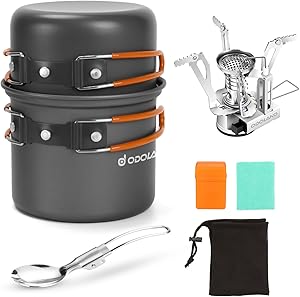
- Inclusions: 2 pots, stove, spork, cloth, bag
- Material: Non-toxic anodized aluminum
- Feature: Foldable heat-resistant handles
- Compatibility: Designed for standard gas tanks
The Odoland 6pcs Cookware Mess Kit is an all-in-one solution for hikers who want a complete kitchen setup in a single purchase. This kit includes two non-stick aluminum pots, a folding stove, a spork, and cleaning accessories. The anodized aluminum construction ensures that the pots conduct heat quickly and evenly, which is essential for efficient cooking and fuel conservation on the trail.
Space-saving is a priority with this set, as the stove and pot handles fold down, allowing the entire kit and a fuel canister to nest together inside the mesh carry bag. It is designed for those who enjoy backpacking with family or friends and want a portable, durable set that is ready to go. This mess kit offers excellent value for beginners and veterans alike.
Pros: Complete kit for a low price, compact nesting design, non-toxic materials.
Cons: Higher total weight for the full kit, non-stick coating requires care.
8. Soto Amicus

- Weight: 11.2 ounces (Total combo)
- Included Pots: 500ml and 1,000ml
- Material: Aluminum
- Ignition: Integrated igniter
The Soto Amicus Stove Cookset Combo is a high-quality, lightweight package that provides everything needed for trail meals. The Amicus stove itself features a recessed burner head, which provides superior wind resistance without the need for a separate screen. This combo includes two aluminum pots (500ml and 1,000ml) that are sized perfectly for solo or duo backpacking trips.
The stove includes an integrated igniter, adding convenience to its list of features. While the total weight of the set is 11.2 ounces, the stove remains in the ultralight category, and the pots are designed to nest the stove and a fuel canister perfectly. It is a reliable, well-engineered option for those who want a matching stove and pot set that performs well in breezy conditions.
Pros: Excellent wind performance, includes two pots, high-quality construction.
Cons: Pots lack a non-stick surface, heavier than titanium alternatives.
9. BRS Ultralight Stove

- Weight: 26 grams (approx. 0.9 oz)
- Power Output: 1940W
- Average Boil Time (1L): 2 min. 58 sec.
- Material: Titanium alloy
The BRS Ultralight Stove is a marvel of minimalist engineering, weighing in at a staggering 26 grams. Made from titanium alloy, it is aimed squarely at the “gram-counting” backpacking community where every fraction of an ounce matters. Despite its tiny size, it is surprisingly powerful, capable of boiling a liter of water in just under three minutes under ideal conditions.
It features simple folding pot supports and a straightforward flame adjustment valve. While it lacks the advanced features like regulators or igniters found on heavier models, its efficiency and footprint are unmatched. This stove is perfect for those who prioritize low weight and small pack volume above all else, provided they are careful to set it up on a stable, level surface.
Pros: World-class lightweight design, extremely fast boil time, titanium durability.
Cons: Very small pot support surface, sensitive to wind.
10. Snow Peak LiteMax

- Weight: 1.9 ounces
- Average Boil Time (1L): 4 min. 25 sec.
- Dimensions: 3 x 2.7 x 1.3 inches
- Fuel: Isobutane-propane
The Snow Peak LiteMax is a premium ultralight stove that manages to stay under the two-ounce mark without feeling flimsy. It is a high-output burner that caters to the needs of serious backpackers who want to minimize their trail weight. The titanium and aluminum construction provides a high strength-to-weight ratio, ensuring the stove can handle the rigors of the backcountry over many seasons.
While its boil time is slightly slower than some of the “speed-focused” competitors, it offers a steady flame and high-quality construction that Snow Peak is known for. The pot supports fold in a unique way to keep the profile slim for storage. This stove is an excellent investment for anyone looking for a reliable, ultralight burner that balances performance with minimalist design.
Pros: Extremely light, premium build quality, very compact storage.
Cons: Slower boil times than some rivals, premium price point.
How to Choose Budget Backpacking Stove
For many hikers, the ritual of boiling water for a freeze-dried meal or a morning coffee is the highlight of a day on the trail. However, entering the world of backcountry cooking can be intimidatingly expensive. While high-end integrated systems can easily clear $150, you don’t need to spend a fortune to get a reliable, hot meal. Choosing an inexpensive backpacking stove is about balancing weight, fuel efficiency, and simmer control without compromising safety.
This guide breaks down everything you need to know to find a wallet-friendly stove that performs when you’re miles from the nearest kitchen.
Understanding the Main Stove Categories
Before looking at price tags, you need to decide which fuel source fits your hiking style. Budget stoves generally fall into four categories:
Canister Stoves
These are the most popular choice for beginners and veterans alike. They screw directly onto a pre-pressurized fuel canister containing a mix of isobutane and propane. They are incredibly easy to use: just screw it on, turn the valve, and light it with a match or piezo igniter. Budget versions of these stoves are often referred to as “pocket rockets” (though that is a brand name) and can be found for as little as $15 to $30.
Alcohol Stoves
If you are a true minimalist, alcohol stoves are the ultimate budget hack. Often made from aluminum soda cans or small brass cups, these stoves burn denatured alcohol or yellow HEET. They have no moving parts to break, are virtually silent, and the stoves themselves are incredibly cheap—sometimes even free if you make one yourself. However, they are slower to boil and require more practice to use safely.
Wood Burning Stoves
A wood-burning “twig stove” uses the environment as its fuel source. By using small sticks and pinecones, you eliminate the need to carry and pay for fuel. While the initial cost of a foldable stainless steel wood stove is low, they require more effort to maintain a flame and are often banned in areas with high fire risk or “Leave No Trace” restrictions.
Liquid Fuel Stoves
Generally, liquid fuel stoves (which run on white gas) are the most expensive upfront. However, if you plan on doing extensive winter camping or international travel where canisters aren’t available, they can be a long-term budget win because the fuel is significantly cheaper than pressurized canisters. For the average three-season hiker, though, these are usually overkill.
Key Factors to Consider When Buying
When you move away from the premium brands, you need to be a more discerning shopper. Here is what to look for to ensure your “bargain” isn’t a “bust.”
Weight and Packability
In the backpacking world, weight is money. Often, cheapest stoves use heavier materials like stainless steel instead of titanium. While a few extra ounces might not seem like much, they add up. Look for a stove that folds down small enough to fit inside your cooking pot. A budget canister stove should ideally weigh between 2.5 and 4 ounces.
Stability and Pot Supports
One common weakness of cheap stoves is flimsy pot supports. If the “arms” of the stove are too short or wobble, you risk tipping over your dinner. Ensure the stove has at least three (ideally four) sturdy supports that can hold the diameter of your specific cook pot. A wide burner head also helps distribute heat more evenly, preventing “hot spots” that burn your food.
Wind Resistance
Wind is the enemy of fuel efficiency. Many budget stoves lack built-in windscreens or “lip” protectors around the burner. If the flame is exposed, a slight breeze can double your boil time, causing you to waste expensive fuel. Consider if the stove’s design offers any protection, or factor in the cost and weight of an aftermarket windscreen (though be careful never to fully enclose a canister stove, as it can explode).
Simmer Control
Are you just boiling water for dehydrated meals, or are you trying to fry a trout or cook “real” food? Many cheap stoves have “on/off” personalities—they are great at full blast but extinguish when you try to turn them down. Look for a stove with a responsive wire gate valve that allows for micro-adjustments if you plan on doing anything more than boiling water.
The Hidden Costs: Fuel Efficiency
A stove that costs $15 but burns through a $6 fuel canister twice as fast as a $50 stove is not actually a bargain in the long run. Canister stoves are generally more efficient than alcohol or wood. To maximize your budget:
- Use a Lid: Always cook with a lid on your pot to trap heat.
- Block the Wind: Use your pack or a rock to create a natural windbreak.
- Turn it Down: You don’t always need a “jet engine” roar. A medium-high flame is often more fuel-efficient than a maximum-output flame.
Safety Considerations for Budget Gear
Safety should never be sacrificed for a lower price. When purchasing an off-brand or budget stove, perform a “dry run” at home before hitting the trail.
Check the O-Rings
The rubber O-ring inside a canister stove is what prevents gas from leaking. On cheaper models, these can sometimes be dry or cracked out of the box. Inspect it regularly. If you smell gas when the stove is attached but turned off, do not light it.
Check for Sharp Edges
Budget manufacturing sometimes leaves “burrs” or sharp edges on the metal. While not a fire hazard, these can easily slice a finger or tear a hole in your expensive lightweight dry bag. A quick rub with some sandpaper can fix this easily.
Top Budget Strategies for Hikers
If you are looking to save money, consider these three specific paths:
The “Amazon Special”
Brands like BRS, Etekcity, and Fire-Maple offer stoves that are remarkably functional for a fraction of the cost of big-name brands. The BRS-3000T, for example, is a titanium stove that is incredibly light and cheap, though it struggles in high wind and with heavy pots. These are great for “weekend warriors.”
The DIY Route
As mentioned, the “Fancy Feast” or “Pepsi Can” alcohol stove is a rite of passage for many ultralight hikers. For the cost of a can of cat food and a bottle of fuel, you have a functional cooking system. It requires patience and technique, but it is the most budget-friendly option in existence.
Buying Used
Stoves are durable. Many people buy high-end stoves, use them once, and then sell them on secondary markets. Checking local gear swaps or online forums can land you a premium stove at a budget price.
Conclusion
Choosing a good value backpacking stove doesn’t mean you have to settle for cold beans and lukewarm coffee. By identifying your primary needs—whether that’s the raw speed of a canister stove or the weightless simplicity of an alcohol burner—you can find a reliable tool that fits your price range. Focus on stability, check your seals, and remember that the best stove is the one that gets you out into the wilderness without breaking the bank.