

Best Sleeping Pads for Couples of 2026
When camping as a couple, sharing a tent can be cozy—until you’re both lying on separate, thin pads that slide apart or leave one person on the hard ground. The right sleeping pad for couples keeps you both comfortable, warm, and connected all night. In this guide, we’ve picked the best options that link together, offer enough cushion, and fit your budget, so you can finally sleep soundly under the stars.
1. Klymit Klymaloft SUMMIT

- Dimensions: 78 x 53 x 5 inches
- Weight: 6 pounds
- R-Value: 2.4
- Pad Thickness: 5 inches
The Klymit Klymaloft Summit is a game-changer for couples who prioritize comfort without hauling a massive mattress. By combining a plush foam topper with supportive I-beam air chambers, it manages to contour to your body while maintaining a stable, high-loft surface. The five-inch thickness ensures that even side sleepers won’t bottom out during the night.
While it is advertised for both camping and backpacking, its six-pound weight makes it a better fit for car camping or very short treks. The inflation process is impressively quick for a double pad, though the lower R-value means it is best reserved for summer and mild shoulder-season trips rather than freezing winter conditions.
Pros: Hybrid foam-air design for extra comfort, massive 5-inch thickness, and rapid inflation.
Cons: Relatively low R-value for cold nights and a bit heavy for traditional backpacking.
See the Klymit Klymaloft SUMMIT
2. Yuzonc Double Sleeping Pad

- Weight: 3 pounds
- Packed Size: 12 x 5.9 inches
- Material: 40D Nylon and TPU coating
- Inflation: Built-in foot pump
The Yuzonc Double Sleeping Pad is built for the weight-conscious adventurer who refuses to sleep on a narrow single mat. At only three pounds, it is incredibly portable and fits easily into most hiking packs. The integrated foot pump is a standout feature, allowing you to fully inflate the mattress in under three minutes without needing a separate electric pump or extra lung power.
The ergonomic water ripple design helps disperse pressure across the surface, providing decent support for two people. However, while the 40D nylon is durable and easy to clean, this pad lacks a high R-value rating, making it most suitable for warm-weather adventures. The built-in pillows are a nice touch for those looking to save even more space in their pack.
Pros: Extremely lightweight and portable, integrated foot pump for easy setup, and budget-friendly.
Cons: Thinner material than heavy-duty mats and lacks significant insulation for winter use.
See the Yuzonc Double Sleeping Pad
3. KLYMIT Insulated Double V
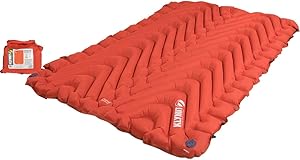
- R-Value: 4.4
- Weight: 52.8 ounces
- Inflated Size: 73 x 47 x 3 inches
- Fabric: 75D Polyester
The Klymit Insulated Double V is a masterclass in efficiency, offering genuine four-season protection in a package that fits easily inside a backpack. Utilizing Klymalite synthetic insulation, it creates a warm barrier against the frozen ground. The signature V-Chamber design is specifically engineered to limit air movement, ensuring that when your partner tosses and turns, you stay undisturbed on your side.
Durability is a major focus here, as the 75D polyester fabric is rugged enough to handle rougher tent floors. The included stuff sack doubles as a pump, taking only about ten pumps to reach full capacity. It is a fantastic option for hikers who need a reliable, warm, and compact sleeping solution for two people in varying climates.
Pros: High R-value for cold weather, innovative air-flow control, and durable 75D fabric.
Cons: Slightly narrower than some luxury camping mats and 3-inch thickness may feel thin for heavy sleepers.
See the KLYMIT Insulated Double V
4. Exped MegaMat Duo

- R-Value: 8.1
- Type: Self-inflating
- Insulation: Open-cell Foam
- Dimensions (LW+): 77.6 x 52 x 4 inches
Widely regarded as the gold standard for luxury car camping, the Exped MegaMat Duo offers a sleeping experience that rivals a home mattress. Its self-inflating open-cell foam provides immense support and pressure relief, making it a favorite for side sleepers who often struggle with traditional air pads. With an R-value of 8.1, it provides exceptional warmth even in extreme cold.
This pad is not intended for the trail; its weight and bulk mean it belongs in the back of a truck or a large family tent. However, for those who value a perfect night’s sleep above all else, the level of comfort and insulation provided is unmatched. The vertical sidewalls allow the two-person surface to remain flat and usable from edge to edge.
Pros: Extreme comfort and insulation, vertical sidewalls maximize space, and high-quality durable materials.
Cons: Very heavy and bulky when packed, and carries a premium price tag.
5. REI Co-op Westward Dreamer

- R-Value: 6.7
- Weight: 9 lbs. 3 oz.
- Dimensions: 76 x 50 x 4 inches
- Type: Self-inflating
The REI Co-op Westward Dreamer is designed for those who want the “glamping” experience without a massive setup. It utilizes a self-inflating design that combines 4 inches of air and plush foam, creating a soft but supportive barrier against the ground. Its high R-value of 6.7 makes it a reliable choice for cold-weather camping, keeping you warm throughout the night.
While the pad is quite heavy at over nine pounds, it offers excellent value for car campers who need a large, reliable double bed. The rectangular shape fits perfectly in standard two-person tents, and the included repair kit provides peace of mind for long-term use. It is a solid, durable investment for frequent weekend warriors who prioritize warmth and thickness.
Pros: High insulation value for winter use, very thick and soft foam, and reliable self-inflation.
Cons: Quite heavy for transport and the packed size is relatively large.
See the REI Co-op Westward Dreamer
6. Klymit Static V SUMMIT

- Weight: 3 lbs. 4.8 oz.
- Packed Size: 7.5 x 11.5 inches
- R-Value: 2.4
- Pad Thickness: 3 inches
The Klymit Static V Summit is an excellent middle-ground option for backpackers who need a double pad that won’t break their back. It strikes a great balance between weight and comfort, featuring Klymit’s famous V-chamber design. This architecture helps distribute air evenly so that movement from one person doesn’t create a “bouncing” effect for the other camper.
The pad packs down remarkably small, roughly the size of a large water bottle, making it one of the most portable insulated double pads available. While its R-value is moderate, it is sufficient for most three-season adventures. It is a rugged and dependable choice for hikers who want to share a bed under the stars without carrying a heavy load.
Pros: Very compact packed size, lightweight for a double pad, and stable V-chamber design.
Cons: Lower R-value limits deep winter use and 3-inch loft may be thin for some.
See the Klymit Static V SUMMIT
7. Exped DeepSleep Duo

- R-Value: 9
- Weight (LW+): 9 lbs. 12.8 oz.
- Type: Self-inflating
- Pad Thickness: 3 inches
The Exped DeepSleep Duo is a simplified, more rugged version of the premium MegaMat series. It focuses on extreme insulation, boasting an R-value of 9 that can handle virtually any temperature the mountains throw at you. Though it has a lower 3-inch profile, the high-density open-cell foam provides a firm and supportive surface that prevents sleepers from feeling the ground.
This mat is designed for campers who need maximum warmth and durability. Its self-inflating mechanism is reliable, though it often requires a few extra breaths or a mini-pump to reach full firmness. It is a heavy-duty option that prioritizes a stable, warm sleeping environment over portability, making it ideal for base camping or winter truck camping.
Pros: Massive R-value for extreme cold, very durable construction, and simple self-inflation.
Cons: Significant weight and bulk, and a lower loft than some other luxury pads.
8. Hikenture Double Sleeping Pad

- Dimensions: 79 x 47.5 x 4 inches
- Weight: 3.65 lbs.
- Material: Polyester Pongee with TPU
- Weight Capacity: 600+ lbs.
The Hikenture Double Sleeping Pad offers a bed-like experience in a lightweight package. Standing four inches thick when inflated, it is a great choice for side and stomach sleepers who need extra cushion. The polyester pongee fabric feels much softer against the skin than typical plastic-feeling nylon mats, and its high weight capacity makes it suitable for larger adults.
Inflation is convenient thanks to the dual-valve system, allowing you to use your foot or hand to pump it up in about five minutes. It folds down to a very manageable size for backpacking, though users should be mindful of the insulation levels in colder weather. For general summer camping and travel, it is an exceptionally comfortable and spacious choice.
Pros: Generous 4-inch thickness, soft-touch fabric, and high weight capacity for two adults.
Cons: Foot pump takes some effort and it lacks a high insulation rating for winter.
See the Hikenture Double Sleeping Pad
9. Big Agnes Captain Comfort Deluxe

- R-Value: 9.9
- Pad Thickness: 5 inches
- Weight: 11 lbs. 2 oz.
- Dimensions: 78 x 52 x 5 inches
If you are looking for the absolute pinnacle of outdoor warmth and cushion, the Big Agnes Captain Comfort Deluxe is the answer. With a staggering 9.9 R-value, this pad is built for the coldest environments on earth. The 5-inch loft, combined with self-inflating foam and stretch fabric, provides a soft-touch feel that mimics a luxury home mattress perfectly.
At over 11 pounds, this is strictly a car-camping pad, but its performance in the field is unrivaled. The closed-cell foam provides a dense, supportive structure that won’t bottom out, even for heavier campers. For those who frequently camp in the snow or simply want the thickest mat available, this Big Agnes model is a premium, high-performance choice.
Pros: Highest R-value in the group, massive 5-inch loft, and incredibly soft stretch fabric.
Cons: Extremely heavy and one of the largest packed sizes on the list.
See the Big Agnes Captain Comfort Deluxe
10. Elegear CumbreX

- R-Value: 9.5
- Inflation: Built-in electric pump
- Material: 50D Knitted fabric and TPU
- Thickness: 4 inches
The Elegear CumbreX stands out for its high-tech approach to camping. It features a built-in electric pump that handles both inflation and vacuum-assisted deflation at the touch of a button. Inside, a memory foam structure adapts to the body’s curves, providing a level of pressure distribution that traditional air pads simply cannot match, all while maintaining a 9.5 R-value.
The 50D knitted fabric is tough and feels premium, making it a great choice for four-season adventures. The integrated pillow is a nice ergonomic touch, though users must ensure the pump is charged before heading out. This pad is perfect for the camper who wants maximum convenience and home-like comfort without the manual labor of pumping or blowing air.
Pros: One-touch electric inflation, memory foam for superior support, and excellent winter insulation.
Cons: Relies on battery power for the pump and is relatively heavy for transport.
The Ultimate Guide to Choosing Sleeping Pads for Couples
For many outdoor enthusiasts, there is nothing quite like sharing a sunset or a sunrise with a partner. However, the romantic appeal of camping can quickly fade if the night is spent sliding between two individual sleeping mats or shivering on a thin piece of foam. Transitioning from solo gear to a double sleeping pad system is a significant upgrade for any camping couple. It not only provides a shared sleeping surface that mimics a bed at home but also improves heat retention and eliminates the dreaded “gap” that forms when two pads drift apart during the night.
In this guide, we will explore the nuances of choosing the right sleeping pad for two people, covering everything from insulation technology to the practicalities of transport and inflation. Whether you are a weight-conscious backpacker or a luxury-focused car camper, understanding the technical specifications of your gear is the first step toward a restful night in the wild.
Understanding Different Types of Double Sleeping Pads
When shopping for a double sleeping pad, the first decision you must make is the construction type. This choice will dictate how much the pad weighs, how small it packs, and how comfortable it feels. There are three primary categories to consider.
Air Pads for Portability
Air pads are the most popular choice for those who need to carry their gear on their backs. These pads rely on air chambers to provide loft. Modern air pads often include internal baffles or “V-chambers” to prevent the air from shifting too much when one person moves. Their primary advantage is their weight-to-thickness ratio; you can often get four or five inches of cushion in a package that weighs less than four pounds. However, they can be noisy when you toss and turn, and they provide no support if they suffer a puncture.
Self-Inflating Pads for Support
Self-inflating pads utilize open-cell foam sandwiched between airtight fabric. When you open the valve, the foam expands and sucks air into the mat. These pads offer a much firmer, more stable feel that closely resembles a traditional mattress. They are also much quieter than pure air pads. The trade-off is weight and bulk; because of the internal foam, these pads are generally much heavier and take up significantly more room in a vehicle or backpack.
Closed-Cell Foam Mats
While rarely sold as “double” pads, some couples use large sheets of closed-cell foam. These are virtually indestructible and provide a consistent, if firm, sleeping surface. However, for most couples, these lack the necessary cushion for side sleeping and are generally used as a protective bottom layer underneath an inflatable pad to increase insulation and prevent punctures.
Key Features to Evaluate Before You Buy
Once you have narrowed down the type of pad, you need to look at the technical specifications. These numbers will tell you if the pad is appropriate for the environment you plan to visit.
The Importance of R-Value
The R-value measures a sleeping pad’s capacity to resist heat loss. When you lie on the ground, the earth acts as a heat sink, pulling warmth away from your body. In a double pad, this is even more critical because there is more surface area in contact with the ground. For summer camping, an R-value of 2.0 to 3.0 is sufficient. For three-season use (spring and fall), look for 4.0 to 5.0. If you plan on camping on snow or in freezing temperatures, you should look for a pad with an R-value of 6.0 or higher.
Dimensions and Tent Fit
Double sleeping pads are not standardized in size. Some are designed to fit perfectly in a two-person backpacking tent (usually around 40 to 45 inches wide), while others are “Queen” sized (60 inches wide) and meant for large cabin tents. Before purchasing, measure the floor dimensions of your tent. There is nothing more frustrating than arriving at a campsite only to realize your luxury mattress is six inches wider than your tent floor, causing the sidewalls to bulge and leak during rain.
Inflation Methods
Inflating a double-sized pad with your lungs can be an exhausting task after a long day of hiking. Look for pads that include a “pump sack”—a bag that captures air and forces it into the mat. This is more hygienic, as it prevents moisture from your breath from entering the pad and causing mold. Some high-end car camping mats even feature built-in electric pumps or integrated foot pumps for maximum convenience.
Addressing the “Partner Disturbance” Factor
The biggest complaint about double sleeping pads is the “bouncy castle” effect. On low-quality air pads, when one person rolls over, the air displacement causes the other person to be tossed upward. To avoid this, look for pads with independent air chambers or internal stabilization structures like I-beams or Klymit’s V-chambers. Higher-end brands like Exped and Big Agnes use dense foam or specialized baffles that isolate movement, ensuring that a restless sleeper doesn’t wake their partner every time they shift positions.
Weight and Packed Size: Backpacking vs. Car Camping
How you get to your campsite is the ultimate deciding factor. For car camping, weight is irrelevant. In this scenario, you should prioritize thickness and comfort. A 10-pound pad like the Exped MegaMat or Big Agnes Captain Comfort offers 4 to 5 inches of foam-supported luxury that is worth every ounce of its weight.
Conversely, for backpacking, every gram counts. Couples can actually save weight by sharing one double pad rather than carrying two single pads, as you eliminate the weight of two extra side-walls. Lightweight double pads from brands like Klymit or Yuzonc pack down to the size of a large water bottle, making them feasible for multi-day treks. However, be prepared to sacrifice some of the plush foam found in the heavier camping models.
Maintenance and Longevity
A double sleeping pad is a significant investment, often costing between $100 and $400. To ensure it lasts for years of adventures, follow these maintenance tips:
- Clear the Ground: Always sweep your tent floor of sharp rocks, sticks, or pine needles before laying down your pad.
- Store it Unrolled: If you have a self-inflating foam pad, store it unrolled with the valves open under a bed or behind a sofa. This preserves the “memory” of the foam so it continues to self-inflate effectively.
- Carry a Repair Kit: Most pads come with a small patch kit. Always keep this in the pad’s stuff sack. A single thorn can ruin a trip if you aren’t prepared to patch a leak in the field.
- Avoid Sunlight: UV rays can degrade the fabric and the lamination of the pad. Never leave your pad baking in a hot car or out in direct sunlight for extended periods.
Conclusion
Investing in a high-quality double sleeping pad is one of the best ways to enhance the outdoor experience for couples. By moving away from separate mats, you create a more cohesive and warm sleeping environment that feels less like “roughing it” and more like a mobile bedroom. By carefully considering the R-value, the inflation style, and the intended use—be it a rugged backcountry trail or a manicured campground—you can find a mattress that ensures both you and your partner wake up refreshed and ready for the next day’s journey.