

Best Self-Inflating Sleeping Pads of 2026
A good night’s sleep under the stars starts beneath you, not above. That’s where a self-inflating sleeping pad comes in. It mixes the cushion of a foam pad with the compact size of an air pad. Simply open the valve, and it pulls in air on its own. This article reviews the best models for comfort, weight, and durability, helping you wake up rested and ready to hit the trail again.
1. REI Co-op Trailmade

- R-Value: 5.5
- Weight: 3 lbs.
- Thickness: 1.5 inches
- Insulation: Open-cell Foam
The REI Co-op Trailmade serves as a versatile bridge between car camping comfort and backpacking portability. It is designed for those who want a single pad that can handle a variety of outdoor scenarios without breaking the bank. The self-inflating mechanism is reliable, providing a firm yet supportive surface that keeps you off the cold ground during chilly nights.
Despite its relatively thin profile of 1.5 inches, the high R-value ensures excellent thermal insulation for four-season use. It is light enough to strap to a pack for shorter backcountry trips while remaining plush enough for a standard campground setup. The rectangular shape offers plenty of room to move around without sliding off the edges during your sleep.
Pros: High insulation rating, versatile for backpacking, durable construction.
Cons: Thinner than dedicated camping mats, slightly heavy for long treks.
2. OGERY Self-Inflating Sleeping Pad

- Dimensions: 77 x 27 x 3 inches
- Weight: 6 lbs.
- Material: Memory Foam
- Special Feature: Built-In Pillow & Pump
The OGERY sleeping pad prioritizes convenience and integrated features for the casual camper. By incorporating a built-in foot pump and an attached pillow, it eliminates the need for extra accessories, making your packing list much shorter. The three-inch thickness combined with memory foam provides a soft, cushioned feel that mimics a residential mattress experience while outdoors.
At six pounds, this pad is strictly for car camping where weight is not a primary concern. The quick deflation valve makes packing up at the end of the trip efficient and stress-free. It is a great choice for taller individuals due to its 77-inch length, providing full-body support and preventing feet from hanging off the end of the mat.
Pros: No external pump needed, very thick cushioning, includes pillow.
Cons: Too heavy for hiking, memory foam can be bulky when packed.
See the OGERY Self-Inflating Sleeping Pad
3. REI Co-op Campwell

- R-Value: 7
- Thickness: 2.5 inches
- Weight: 3 lbs. 8 oz. (Regular)
- Shape: Rectangular
The REI Co-op Campwell is a dedicated car-camping mat that emphasizes a soft-touch surface and high-end insulation. With an R-value of 7, it is exceptionally warm, making it an ideal companion for winter camping or for sleepers who struggle to stay warm in a tent. The supple exterior fabric feels great against the skin even if you aren’t using a liner.
The 2.5-inch thickness offers a significant upgrade in comfort over standard backpacking pads without becoming overly difficult to roll up. It includes a repair kit for peace of mind in the field and a sturdy stuff sack for storage. This pad is perfect for those who want a reliable, warm, and highly comfortable foundation for their tent setup.
Pros: Exceptional warmth for winter, soft fabric, includes repair kit.
Cons: Not suitable for backpacking, larger packed size.
4. Coleman Silver Springs

- R-Value: 5
- Thickness: 3 inches
- Weight: 5 lbs.
- Insulation: Synthetic
The Coleman Silver Springs is a budget-friendly powerhouse designed for campers who prioritize loft and thickness. At three inches thick, it does an excellent job of smoothing out uneven ground and hidden roots. The synthetic insulation provides a solid thermal barrier, ensuring that the cold ground doesn’t sap your body heat during the night.
While it is heavier and bulkier than some competitors, it offers a level of durability often associated with the Coleman brand. It is a straightforward, no-nonsense pad that is easy to deploy and pack away. If you are looking for maximum cushion on a budget for occasional weekend trips, this model provides great value for its price point.
Pros: Very affordable, thick padding, reliable durability.
Cons: Narrow width, heavy weight for its size.
See the Coleman Silver Springs
5. Elegear CumbreX
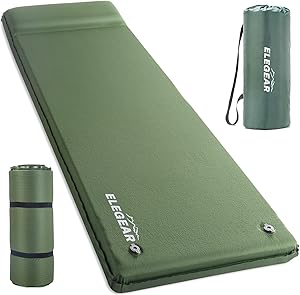
- Thickness: 3.15 inches
- Weight: 8.1 lbs.
- Material: 26D Hi-tech Foam
- Structure: Waterproof TPU Layer
The Elegear CumbreX stands out for its use of high-density 26D memory foam, which offers superior support compared to the industry standard. This pad is built for luxury, featuring a stretch knitted fabric top that is both quiet and soft. The waterproof TPU layer ensures that moisture from the ground or spills won’t compromise the foam interior.
This is a heavy-duty pad designed for those who want a “home bed” feel in the wilderness. The dual-use valve makes inflation and deflation much faster than traditional twist valves. While its weight of over eight pounds makes it the heaviest on the list, the trade-off is an incredibly stable and supportive sleeping surface for any adult camper.
Pros: High-density foam, waterproof, very comfortable surface.
Cons: Extremely heavy, takes up significant trunk space.
6. Gear Doctors Oxylus

- Weight: 2.2 lbs.
- Thickness: 1.5 inches
- Dimensions: 72 x 22 inches
- Material: Polyester
The Gear Doctors Oxylus is the most lightweight and compact option on this list, specifically tailored for the minimalist traveler or backpacker. Its self-inflating design is fine-tuned for quick setup at the end of a long day of hiking. The adjustable air pressure allows users to customize the firmness to their personal preference easily.
Despite its slim profile, it provides a protective layer against the cold and hard ground. It is designed to be easily carried inside or outside a pack without adding significant bulk. For those who need to move light but still want the convenience of a self-inflating foam core, the Oxylus offers a great balance of performance and portability.
Pros: Lightweight, very compact, adjustable firmness.
Cons: Narrow dimensions, minimal padding for side sleepers.
7. Exped MegaMat

- R-Value: 8.1
- Thickness: 4 inches
- Weight: 4 lbs. 9 oz. (Medium Wide)
- Insulation: Open-cell Foam
The Exped MegaMat is widely regarded as the gold standard for camping comfort, specifically for side sleepers. With four inches of loft, it effectively eliminates any pressure points on the hips and shoulders. The massive 8.1 R-value means this pad can handle extreme cold, making it a favorite for basecamp expeditions in harsh conditions.
The vertical sidewalls create a flat, level sleeping surface from edge to edge, maximizing the usable space. It includes a high-quality stuff sack and a repair kit, reflecting its premium positioning. If you are looking for the absolute best night’s sleep possible while camping and don’t mind the premium price, the MegaMat is the top contender.
Pros: Best-in-class comfort, incredible warmth, edge-to-edge support.
Cons: Expensive, bulky to store when not in use.
8. NEMO Roamer

- R-Value: 7
- Thickness: 4 inches
- Weight: 5 lbs. 8 oz. (Regular X-Wide)
- Packed Size: 10 x 16 inches
The NEMO Roamer aims to provide the plushness of a massive camping mat while maintaining a surprisingly small packed size. NEMO’s engineering allows this four-inch pad to fold and roll down more efficiently than most of its competitors. This makes it an excellent choice for those with smaller vehicles who still want luxury-level comfort at the site.
It features a toggled system that allows you to link two pads together for a seamless double-bed experience. The high R-value and premium fabrics make it feel like a true bed replacement. It’s a high-performance mat that doesn’t compromise on thickness or insulation, serving the needs of discerning campers who value both space and comfort.
Pros: Packs smaller than rivals, luxurious thickness, linkable design.
Cons: High price point, takes effort to fully deflate.
9. Therm-a-Rest MondoKing 3D

- R-Value: 7.0
- Thickness: 4.25 inches
- Weight: 4 lbs. 6 oz. (Large)
- Insulation: Open-cell Foam
The MondoKing 3D is the pinnacle of the Therm-a-Rest line, offering the greatest thickness at 4.25 inches. Its vertical sidewalls provide 20% more usable sleep surface than traditional tapered pads, allowing you to sprawl out comfortably. The TwinLock valve system utilizes two dedicated one-way valves for lightning-fast inflation and deflation.
This pad is built for frontcountry luxury, providing a stable and warm foundation even in sub-zero temperatures. The foam core offers a consistent feel that doesn’t “bottom out” when you sit up. It is the ideal choice for anyone who prioritizes support and wants the most advanced valve technology available in a self-inflating mat.
Pros: Thickest pad on the list, excellent valve system, huge sleep surface.
Cons: Very large packed dimensions, high cost.
See the Therm-a-Rest MondoKing 3D
10. Therm-a-Rest BaseCamp

- R-Value: 6.0
- Thickness: 2 inches
- Weight: 2 lbs. 8 oz. (Regular)
- Shape: Rectangular
The Therm-a-Rest BaseCamp is a classic choice that balances the reliability of a heritage brand with straightforward comfort. With a two-inch thickness, it provides a firm and stable sleeping surface that is much easier to manage than the oversized 4-inch luxury pads. The R-value of 6.0 ensures it is a true year-round performer.
Because it is lighter and more manageable than its larger siblings, the BaseCamp is a great choice for campers who move sites frequently. It offers the high build quality Therm-a-Rest is known for, featuring durable fabrics that resist punctures. It’s a dependable, “workhorse” pad that provides plenty of warmth for any car-camping adventure.
Pros: Lightweight for a camping pad, very durable, high R-value.
Cons: Less cushioning than 3-inch+ pads, basic aesthetic.
How Self-Inflating Sleeping Pads Work and How to Use Them
The self-inflating sleeping pad revolutionized the outdoor industry when it was first introduced, offering a perfect middle ground between the bulky, heavy foam mats of the past and the thin, uncomfortable air mattresses that preceded them. For modern campers and backpackers, understanding the mechanics, maintenance, and proper usage of these pads is essential for ensuring a warm and comfortable night’s sleep in the wilderness. This guide explores the technology behind these pads and provides a comprehensive manual on how to maximize their performance.
The Science of Self-Inflation
At the heart of every self-inflating pad is a core of open-cell foam. Unlike closed-cell foam, which is dense and rigid, open-cell foam consists of a network of interconnected air pockets. When the pad is rolled up and the valve is closed, this foam is compressed, and the air is forced out. Because the foam has “memory,” it naturally wants to return to its original, expanded shape.
When you arrive at camp and open the valve, the atmospheric pressure outside the pad is higher than the pressure inside the compressed foam. This causes air to rush into the pad, filling the open cells and expanding the foam to its full loft. This dual-layer system—foam for support and insulation, and air for cushioning—provides a stable surface that prevents the “bouncing” sensation often found in traditional air mattresses.
The Role of Insulation and R-Value
One of the primary functions of a sleeping pad is not just comfort, but thermal insulation. The ground, regardless of the air temperature, acts as a heat sink, pulling warmth away from your body through conduction. The open-cell foam inside a self-inflating pad traps air in non-circulating pockets. This trapped air acts as a barrier, preventing the cold ground from reaching your back.
This insulating capacity is measured by the R-value. A higher R-value indicates better thermal resistance. Most self-inflating pads offer R-values between 2.0 and 7.0. For summer camping, a lower R-value is sufficient, but for winter or alpine conditions, a pad with a high R-value is critical for survival and comfort.
How to Set Up Your Sleeping Pad
While the name suggests the pad does all the work, there are several steps you should take to ensure the best possible setup. Proper deployment ensures that the foam is fully lofted and the pad is adjusted to your specific firmness preference.
Initial Deployment
Once you have chosen a flat, debris-free spot for your tent, unroll the pad completely. Locate the valve—usually located at one of the corners—and twist or pull it to the open position. You will likely hear a distinct “hiss” as the air begins to enter the chamber. It is best to let the pad sit for at least 15 to 30 minutes. During this time, you can set up the rest of your camp or prepare a meal.
Topping Off and Adjusting Firmness
A self-inflating pad will rarely reach 100% of its potential firmness on its own. To achieve the desired level of support, you will need to “top it off” by blowing a few breaths of air into the valve manually. Be careful not to over-inflate the pad, as this can put unnecessary strain on the seams and internal baffles. Once the pad feels firm enough, close the valve securely.
Maintenance and Care for Longevity
A high-quality self-inflating pad is an investment that can last for a decade or more if treated correctly. Most failures in these pads are caused by improper storage or accidental punctures, both of which are avoidable with a bit of knowledge.
Cleaning and Drying
After a trip, your pad may have accumulated dirt, sweat, or oils from your skin. Use a damp cloth with mild, non-detergent soap to wipe down the exterior. Never machine wash or dry a sleeping pad, as the heat and agitation will destroy the internal foam and the waterproof TPU coating. Always ensure the pad is completely dry before rolling it up, as moisture trapped inside or on the surface can lead to mold and mildew growth.
Proper Storage Techniques
The most common mistake campers make is storing their pads rolled up tight in their stuff sacks for months at a time. Long-term compression damages the “memory” of the open-cell foam, meaning it will eventually lose its ability to self-inflate. The best way to store a self-inflating pad is unrolled, with the valve open, in a cool, dry place like under a bed or behind a sofa. This allows the foam to remain relaxed and ensures any residual moisture can escape.
Field Repairs: Handling Punctures
Even the most durable pads can fall victim to a sharp rock or a stray thorn. Learning how to repair a leak in the field is a vital skill. Most manufacturers include a small repair kit with the purchase of a pad, containing adhesive and fabric patches.
Locating the Leak
If you wake up on the hard ground, you have a puncture. To find it, inflate the pad as much as possible. If you are near a body of water, submerge sections of the pad and look for bubbles. If not, apply a mixture of water and biodegradable soap to the surface; the escaping air will create a visible bubble over the hole. Once found, dry the area completely and mark the spot.
Applying the Patch
Clean the area around the hole with an alcohol prep pad. Apply a small amount of adhesive to the patch and the pad, wait for it to become tacky, and then press the patch firmly over the hole. It is best to let the adhesive cure for several hours—or as long as the instructions dictate—before re-inflating the pad and putting weight on it.
Advanced Tips for Maximum Comfort
To truly master the use of your pad, consider these professional tips used by experienced backcountry guides:
- Temperature Sensitivity: Foam becomes stiffer in cold weather. If you are winter camping, the self-inflation process will be much slower. You may need to provide more manual breaths than usual.
- Elevation Changes: If you inflate your pad at a low elevation and then drive to a high-altitude trailhead, the air inside will expand. This can potentially cause a “blowout.” Always keep your valve open when traveling through significant elevation changes.
- The “Side Sleeper” Trick: If you sleep on your side, you may find the pad feels too hard. To fix this, lie on the pad and slightly crack the valve to let a tiny bit of air out until your hip just barely clears the ground. This creates a custom mold for your body shape.
Conclusion
The self-inflating sleeping pad is a remarkable piece of outdoor technology that provides a reliable foundation for rest. By understanding how the open-cell foam interacts with air pressure, and by following a strict regimen of proper storage and care, you can ensure that your pad remains a faithful companion on your adventures for years to come. Remember that a pad is only as good as the care you give it—treat it well, and it will keep the cold at bay and the comfort at a maximum.