Best Sleeping Pads for Thru-Hiking of 2026
If you’re planning a long hike, a good night’s sleep makes all the difference. The right sleeping pad keeps you off the hard, cold ground and helps your body recover for the next day’s miles. But with so many options, how do you choose? This guide breaks down the best sleeping pads for thru-hiking—lightweight, comfy, and tough enough for the trail.
1. Therm-a-Rest NeoAir XLite NXT

- R-Value: 4.5 — suitable for 3-season and cold-weather backpacking
- Weight: Starts at 11.5 oz. (Short) — qualifies as ultralight
- Packed Size: 4.1 x 9 inches (Short/Regular) — extremely compact
- Thickness: 3 inches across all sizes for consistent comfort
The Therm-a-Rest NeoAir XLite NXT is a benchmark in ultralight sleeping pad technology, engineered specifically for backpackers who refuse to compromise on sleep quality. Its 4.5 R-value makes it a reliable choice across three seasons and even shoulder-season cold, while the mummy shape minimizes bulk without sacrificing coverage. The inclusion of a stuff sack and repair kit adds practical value straight out of the box.
Available in four sizes — Short, Regular, Regular Wide, and Large — it accommodates a wide range of sleepers. The 3-inch thickness delivers genuine cushioning on uneven terrain, and the pad’s minimal packed size means it won’t dominate your pack. Whether you’re logging high-mileage days in the backcountry or fast-and-light alpine missions, this pad earns its place as a top-tier choice.
Pros:
- Exceptional warmth-to-weight ratio
- Ultra-compact packed size
- Multiple size options available
- Repair kit and stuff sack included
Cons:
- Premium price point
- Can be noisy when moving during sleep
See the Therm-a-Rest NeoAir XLite NXT
2. KLYMIT Insulated Static V Lite

- R-Value: 4.4 — four-season insulation with Klymalite synthetic fill
- Weight: 20 oz. packed — reasonable for an insulated air pad
- Packed Size: 8 x 3 inches — compact enough for most packs
- Inflated Size: 72 x 23 x 2.5 inches — generous sleeping surface
The KLYMIT Insulated Static V Lite is purpose-built for campers who want reliable warmth without hauling excess gear. Its signature V-Chamber design maps to the body’s natural contours, reducing internal air movement so heat stays where you need it. Dynamic side rails provide subtle but effective cradling, making it a comfortable option for back, side, and stomach sleepers alike. With just 10–15 breaths to full inflation, setup is fast and effortless.
The Klymalite synthetic insulation gives this pad genuine cold-weather credibility, offering a 4.4 R-value in a compressible, lightweight package. The 30D polyester shell is durable enough for regular use on varied terrain. For campers seeking an affordable, four-season-capable pad that inflates quickly and packs down small, the Static V Lite delivers solid performance and comfort at a competitive price.
Pros:
- Body-mapping V-Chamber design for comfort
- Four-season insulation capability
- Quick 10–15 breath inflation
- Affordable price for features offered
Cons:
- Heavier than competing ultralight options
- Packed size slightly bulkier than top-tier competitors
See the KLYMIT Insulated Static V Lite
3. Exped Ultra 3R

- R-Value: 3.2 — rated for 3-season use with synthetic insulation
- Weight: From 1 lb. 0.5 oz. (Medium) — light for an insulated pad
- Packed Size: 4.3 x 9.1 inches (Medium) — highly packable
- Thickness: 3 inches across all size variants
The Exped Ultra 3R hits a compelling sweet spot between weight savings and insulated warmth, making it a natural pick for three-season backpacking and bikepacking. Its rectangular shape offers more sleeping room than mummy-style alternatives, particularly appreciated by those who move around during the night. Synthetic insulation keeps the pad functional even in damp conditions, and both repair kit and stuff sack are included for complete out-of-the-box readiness.
Offered in Medium, Medium Wide, and Long Wide sizes, the Ultra 3R scales well across different body types without a dramatic weight penalty. The 3-inch loft ensures solid ground separation on rocky or uneven surfaces. For human-powered adventurers prioritizing pace and pack weight, this pad’s 3.2 R-value and compact packed dimensions make it a highly capable, well-rounded 3-season companion that holds up on demanding trips.
Pros:
- Rectangular shape offers more space
- Performs well in wet conditions
- Repair kit and stuff sack included
- Great for backpacking and bikepacking
Cons:
- R-value limits use in harsh winter conditions
- Slightly heavier than non-insulated alternatives
4. Therm-a-Rest NeoAir XTherm NXT

- R-Value: 7.3 — exceptional warmth for extreme cold conditions
- Weight: From 15.5 oz. (Regular) — ultralight given the warmth provided
- Packed Size: 4.5 x 9 inches (Regular) — impressively compact for winter use
- Thickness: 3 inches across Regular, Regular Wide, and Large
When the mercury drops and the backcountry gets serious, the Therm-a-Rest NeoAir XTherm NXT stands in a class of its own. An R-value of 7.3 makes it one of the warmest ultralight sleeping pads on the market, capable of handling the most demanding winter and high-altitude conditions without flinching. Its mummy shape reduces material weight while the 3-inch loft ensures you’re well-insulated from even frozen ground.
Despite its extreme thermal performance, the XTherm NXT packs down to a remarkably small footprint — 4.5 x 9 inches for the Regular — and starts at just 15.5 oz., a feat that speaks to Therm-a-Rest’s engineering pedigree. Three size options cover most body types, and the included repair kit and stuff sack round out a package that serious alpine and winter backpackers will find hard to beat on warmth-per-ounce grounds.
Pros:
- Industry-leading 7.3 R-value for winter use
- Ultralight despite exceptional insulation
- Compact packed size for a 4-season pad
- Durable build quality from a trusted brand
Cons:
- High price tag
- Overkill for warm-weather camping
See the Therm-a-Rest NeoAir XTherm NXT
5. Gear Doctors ApolloAir
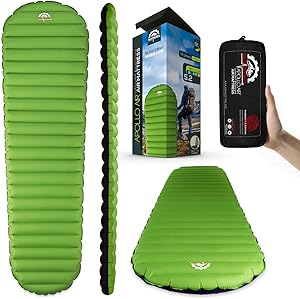
- Dimensions: 72.08 x 22 x 3.25 inches inflated — spacious full-length coverage
- Weight: 1.06 lbs. — lightweight for its size and feature set
- Material: Nylon construction — durable and weather-resistant shell
- Included: Carry bag, pump sack, and repair patch — complete kit
The Gear Doctors ApolloAir is a budget-friendly air pad that punches above its price class in terms of comfort and convenience. The included pump sack eliminates the need for mouth inflation, speeding up setup considerably while keeping moisture out of the pad’s interior. At 3.25 inches thick and 22 inches wide, it offers a generous sleep surface suited to a wide range of adult sleepers on varied terrain.
Weighing just over a pound, the ApolloAir is compact and light enough for backpacking trips where weight savings matter. The nylon shell handles the rigors of regular outdoor use, and the bundled repair patch means minor punctures don’t have to cut a trip short. For campers who want reliable comfort at an accessible price without hauling heavy gear, this pad is a smart, practical pick that covers the essentials well.
Pros:
- Affordable entry-level price
- Pump sack included for easy inflation
- Generous 3.25-inch thickness
- Complete kit with carry bag and repair patch
Cons:
- No published R-value for insulation rating
- Less brand recognition than established competitors
See the Gear Doctors ApolloAir
6. Therm-a-Rest Z Lite Sol

- R-Value: 2.0 — suited for spring through fall camping conditions
- Weight: 10 oz. (Small), 14 oz. (Regular) — ultralight closed-cell foam
- Thickness: 0.75 inches — compact accordion-fold design
- Packed Size: 20 x 5.5 x 4 inches (Small) — folds flat for external carry
The Therm-a-Rest Z Lite Sol is the go-to closed-cell foam pad for weight-conscious backpackers who value indestructible simplicity over plush comfort. Its accordion fold design packs tightly and can be strapped to the outside of a pack without adding meaningful bulk. The heat-trapping dimple pattern and reflective ThermaCapture coating boost its thermal efficiency beyond what basic foam pads deliver, achieving a 2.0 R-value that handles three-season use reliably.
Unlike air pads, there’s nothing to puncture or inflate — the Z Lite Sol is ready the moment you unroll it, and it shrugs off moisture, abrasion, and rough handling without a second thought. It works equally well as a standalone pad in mild conditions or as an insulating layer beneath a higher R-value air pad in winter. Ultralight, maintenance-free, and time-tested, it remains one of the most dependable pieces of sleep kit available.
Pros:
- Virtually indestructible — nothing to puncture
- No inflation needed, instant deployment
- Reflective coating adds warmth efficiency
- Extremely lightweight and affordable
Cons:
- Less comfortable than air pad alternatives
- Lower R-value limits cold-weather use
See the Therm-a-Rest Z Lite Sol
7. Sea to Summit Ultralight XR

- R-Value: 3.6 — insulated with ThermalCore synthetic for cold nights
- Weight: From 13.8 oz. (Short) — ultralight insulated air pad
- Thickness: 2.6 inches with 151 Air Sprung Cells for pressure relief
- Packed Size: 3.9 x 7.5 inches (Short/Regular) — one of the smallest available
The Sea to Summit Ultralight XR Insulated sleeping pad is a technical achievement for cold-weather backpackers who count every gram. Its 151 Air Sprung Cells act independently to conform to body contours and reduce pressure points, offering noticeably better support than flat-chamber pads. ThermalCore insulation reflects body heat back efficiently, achieving a 3.6 R-value that confidently handles three seasons and cool nights with ease.
The packed size is genuinely remarkable — the Regular compresses to just 3.9 x 7.5 inches, making it one of the smallest insulated pads on the market. Despite this, it retains a mummy shape offering over 21 inches of width, giving most sleepers adequate room. The included repair kit and stuff sack complete the package. For ultralight travelers who don’t want to sacrifice warmth for packability, the XR Insulated is a standout performer.
Pros:
- One of the smallest packed sizes for an insulated pad
- Air Sprung Cells reduce pressure points effectively
- Repair kit and stuff sack included
- Strong warmth-to-weight-to-volume ratio
Cons:
- 2.6-inch thickness less cushioning than 3-inch competitors
- Premium pricing for the insulated model
See the Sea to Summit Ultralight XR
8. Sea to Summit Ultralight Air

- R-Value: 1.1 — designed for warm-weather and summer backpacking
- Weight: From 12.2 oz. (Short) — ultralight three-season air pad
- Packed Size: 3.5 x 7 inches (Short/Regular) — exceptionally compact
- Thickness: 2 inches with integrated pump for easy inflation
The Sea to Summit Ultralight Air Mat is built for warm-weather backpackers who want the lightest possible sleep system without excess bulk. Starting at just 12.2 oz. for the Short size and packing to a tiny 3.5 x 7 inches, it earns its ultralight designation without argument. The integrated pump sack simplifies inflation — no blowing required — and the mummy shape trims material weight while providing adequate sleeping width for most users.
With an R-value of 1.1, this pad is best deployed in summer conditions or paired with a warmer layer for shoulder-season trips. The 2-inch thickness offers comfortable ground separation on soft surfaces like trail dirt or sand, though rocky terrain may demand the additional loft of a thicker pad. For gram-counters targeting hot summer routes, the Ultralight Air’s minimal weight and tiny pack footprint are genuinely hard to beat.
Pros:
- Exceptionally minimal packed size
- Integrated pump for effortless inflation
- Among the lightest options available
- Repair kit and stuff sack included
Cons:
- Low R-value limits use to warm conditions only
- 2-inch thickness may feel thin on rough ground
See the Sea to Summit Ultralight Air
9. NEMO Switchback

- R-Value: 2.0 — closed-cell foam with heat-reflecting film for added warmth
- Weight: 10.5 oz. (Short), 14.5 oz. (Regular) — lightweight foam construction
- Thickness: 0.9 inches — slightly thicker than competing foam pads
- Packed Size: 20 x 5.5 x 5 inches (Regular) — accordion fold, external carry
The NEMO Switchback brings a refined approach to the classic closed-cell foam pad, adding a heat-reflecting film that pushes warmth retention beyond standard foam at the same weight class. At 0.9 inches thick — slightly more than many foam competitors — it delivers a meaningful upgrade in cushioning and comfort, particularly appreciated on hard or rocky ground. The accordion fold design deploys instantly and survives any weather condition without maintenance concerns.
Like all closed-cell pads, the Switchback’s greatest strength is its indestructibility — there’s nothing to puncture, no valves to fail, and no inflation required. Its 2.0 R-value covers three-season conditions and it layers seamlessly beneath an air pad in winter. At under 15 oz. for the Regular, it’s a rugged, reliable, and genuinely versatile pad that earns a permanent spot in backpacking kits where simplicity and durability matter most.
Pros:
- Puncture-proof closed-cell construction
- Heat-reflecting film boosts warmth efficiency
- Slightly thicker than most foam pad competitors
- No inflation required — instant setup
Cons:
- Less comfortable than air pads over long trips
- Bulkier than inflatable alternatives for pack storage
10. FUN PAC Camping Sleeping Pad
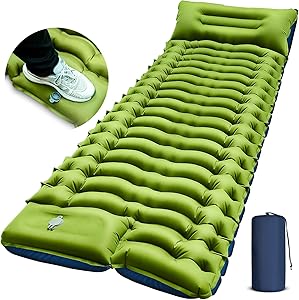
- Dimensions: 78 x 27 x 8 inches inflated — extra wide with exceptional thickness
- Material: 40D nylon and TPU — durable, weather-resistant construction
- Inflation: Built-in pump inflates in 30–60 seconds — no external tools needed
- Feature: Side buttons allow two pads to connect for a twin sleeping surface
The FUN PAC Camping Sleeping Pad is designed with family campers and comfort-focused outdoorspeople in mind, offering a generously sized 78 x 27-inch platform with a remarkable 8-inch loft for hotel-like ground separation. The built-in pump makes inflation a 30–60 second affair, and the integrated pillow saves you from packing a separate one. Egg-shaped air cells distribute weight evenly, reducing back and neck pressure for back, side, and stomach sleepers throughout the night.
The 40D nylon and TPU construction handles the wear and tear of regular camping use, and the dual-layer valve prevents air leakage for reliable overnight firmness. A standout feature is the side button system that connects two pads into a double bed — ideal for couples or families camping together. Despite the substantial inflated size, it compresses to water-bottle proportions for easy pack storage, making it a versatile, comfort-first choice for campsite use.
Pros:
- Extra-wide 27-inch and 8-inch thick for maximum comfort
- Built-in pump for fast, effortless inflation
- Connects with a second pad to create a double bed
- Integrated pillow eliminates need for extra gear
Cons:
- No published R-value for thermal performance
- Better suited to car camping than ultralight backpacking
See the FUN PAC Camping Sleeping Pad
The Thru-Hiker’s Guide to Sleeping Pads: Balancing Comfort, Weight, and Warmth
For a thru-hiker, the sleeping pad is arguably the most underrated piece of gear in the “Big Three” (tent, backpack, and sleep system). While a high-quality sleeping bag or quilt provides the loft to keep you warm from above, it is the sleeping pad that protects you from the literal heat sink of the earth. On a long-distance journey like the Appalachian Trail or the Pacific Crest Trail, you will spend approximately one-third of your time lying on this piece of equipment. Choosing the right pad is not just about comfort; it is about recovery, safety, and the physical longevity required to walk 2,000 miles.
Understanding the Core Functions of a Sleeping Pad
Before diving into specific models, it is essential to understand what a sleeping pad actually does. Its primary purpose is twofold: cushioning and insulation. Cushioning is a matter of comfort—keeping your hips and shoulders from grinding into the hard ground. Insulation, measured by R-value, is a matter of biology. The ground will conduct heat away from your body much faster than the air will. Without a pad with an appropriate R-value, even the most expensive 0-degree sleeping bag will fail to keep you warm because the insulation underneath you is compressed and useless.
Types of Sleeping Pads for Thru-Hiking
Thru-hikers generally choose between three categories of pads. Each has a dedicated following based on the specific trade-offs between weight, durability, and ease of use.
Closed-Cell Foam (CCF) Pads
Closed-cell foam pads, like the iconic NEMO Switchback or Therm-a-Rest Z Lite, are the simplest option. They are made of dense foam filled with tiny air bubbles. For many “purist” thru-hikers, these are the gold standard because they are indestructible. You can throw them on sharp rocks during a lunch break, and they will never pop. They are also the lightest and most affordable options. However, they provide the least amount of cushioning and are bulky, usually requiring the hiker to strap them to the outside of their pack.
Inflatable Air Pads
Air pads have become the most popular choice for modern thru-hikers. They offer 2 to 4 inches of loft, which is a godsend for side sleepers. When deflated, they shrink to the size of a water bottle, allowing for a more streamlined pack. The downside is the risk of punctures and the “crinkle” noise associated with the reflective film used for insulation. A single thorn or a sharp rock can render an air pad useless, necessitating a field repair kit.
Self-Inflatable Pads
Self-inflating pads are a hybrid, featuring an open-cell foam core inside an airtight fabric shell. When you open the valve, the foam expands and sucks in air. These offer a “best of both worlds” feel in terms of stability, but they are generally too heavy and bulky for most thru-hikers. They are rarely seen on long-distance trails today where every ounce counts.
The Critical Metric: R-Value Explained
The R-value measures a pad’s resistance to heat loss. The higher the number, the better the pad insulates you from the cold ground. For a thru-hike, your needs will change depending on the season and the geography.
Summer and Low Elevation (R-Value 1.0 to 2.5)
In the heat of the mid-Atlantic summer on the AT, a high R-value can actually make you feel uncomfortably warm. Pads in this range are lightweight and breathable but should be traded out when the temperature drops below 40°F.
Three-Season Performance (R-Value 3.0 to 4.5)
This is the “sweet spot” for most thru-hikers. A pad with an R-value around 3.5 to 4.0 will keep the average sleeper warm down to freezing temperatures. This is usually sufficient for a standard March-to-September thru-hike, covering everything from early spring in Georgia to late summer in Maine.
Winter and High Alpine (R-Value 5.0+)
If you are starting a hike in February or traversing the High Sierra in a high-snow year, you need serious insulation. Many hikers achieve this by stacking a CCF pad (R-value ~2.0) under an inflatable pad (R-value ~3.0) to create a combined barrier against the frozen ground.
Weight vs. Comfort: The Thru-Hiker’s Dilemma
Every gram counts when you are climbing 3,000 feet a day. However, a “weight-weenie” approach to sleeping pads can lead to “trail burnout” if you aren’t sleeping well. Small adjustments in pad dimensions can save significant weight.
The Short vs. Regular Length Debate
Ultralight hikers often use “torso-length” pads (typically 48 inches). These pads support the head, shoulders, and hips, while the hiker uses their empty backpack to cushion their legs and feet. This can save 4 to 6 ounces, which is a massive reduction in “base weight.” However, for many, the lack of full-body cushioning leads to restless nights.
Mummy vs. Rectangular Shapes
Mummy-shaped pads taper at the feet to shave off unnecessary fabric and foam. Rectangular pads provide more surface area, preventing your arms from falling off the sides of the pad. If you are a restless sleeper who tosses and turns, the extra few ounces of a rectangular pad are usually worth the weight for the improved sleep quality.
Durability and Maintenance on the Trail
On a thru-hike, your gear is subjected to extreme abuse. Proper care can determine whether your pad lasts 200 miles or 2,000 miles.
Site Selection
Before setting up your tent, spend sixty seconds clearing the ground. Remove every pebble, twig, and pinecone. Not only does this protect your inflatable pad from punctures, but it also ensures a more level sleeping surface. If you are using an inflatable pad, consider using a thin “polycro” ground cloth or a 1/8-inch foam pad underneath it for an extra layer of protection.
The Moisture Problem
When you blow into an inflatable pad with your lungs, you are introducing warm, moist air into the interior. Over months of use, this moisture can lead to mold growth or cause the internal reflective baffles to delaminate. Most high-end pads now come with a “pump sack.” Use it. It saves your lungs after a long day of hiking and keeps the inside of your pad dry.
Final Recommendations for the Long Haul
If you are preparing for a thru-hike, do not make your final decision based on a YouTube review. Go to an outdoor retailer and lie down on different pads. Pay attention to the noise; some pads sound like a bag of potato chips every time you move, which can be a nuisance to both you and your camp neighbors in a crowded shelter.
For the budget-conscious and the “indestructible” hiker, a closed-cell foam pad is a rite of passage. For those who prioritize recovery and have a bit more room in their budget, a high-quality inflatable pad with an R-value of at least 3.5 is the most versatile tool for the job. Remember, the goal of a thru-hike is to keep walking, and nothing facilitates movement better than a good night’s rest.